
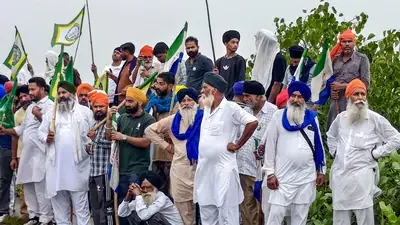
A day after the Cockroach Janta Party (CJP) protest that shook the streets of Delhi, farmers from Punjab and Haryana are now marching on the national capital with their own demands, adding to the authorities’ headache.
Event Context
A Kisan Mahapanchayat, under the banner of ‘Desh Bachao Morcha’, against the proposed India-US trade deal, is planned at Delhi’s Kisan Ghat on Tuesday. Farmer leaders had earlier said participants from several places, including Punjab, Haryana, Rajasthan and Himachal Pradesh, would attend the Mahapanchayat.
Two groups of farmers, one from Haryana and another from Punjab, are making their way towards Delhi. However, the Punjab group was stopped by the police at the Shambhu border. A blockade has also been put at Khanauri.
Both Sambhu and Khanauri serve as entry points into Haryana from Punjab. Prohibitory orders under BNS section 163 are in force at both places.
Two companies of the RAF and one company of the Haryana police were deployed at the Panipat toll plaza on NH-44 to stop a group of Haryana farmers, which had started a foot march to Delhi from Karnal.
The Union government officials have maintained that India will not sacrifice its core agricultural interests to conclude the trade agreement. The government has also stressed that safeguards will be built into any final pact to protect domestic farmers.
Union commerce minister Piyush Goyal has previously said that India will not implement any agreement unless it ensures benefits for the country and its stakeholders.
The government’s position has been that the proposed deal should create opportunities for businesses, farmers, workers and consumers without compromising India’s key interests.
Match Outlook
Farmer organisations, including the Kisan Mazdoor Morcha, argue that allowing cheaper agricultural imports from the US could severely impact Indian farmers, agricultural labourers, livestock rearers and small traders.
They fear highly subsidised American agricultural products could flood the Indian market, driving down domestic crop prices and hurting rural incomes. Their concern is that Indian farmers, who receive far lower government support than their US counterparts, would struggle to compete.
source
According to the protesting unions, the proposed agreement could extend beyond a few agricultural commodities and eventually cover dairy, industry, digital trade, e-commerce, government procurement, intellectual property rights and services.
The unions have urged the Centre to scrap the proposed India-US trade agreement and protect the interests of farmers and ordinary citizens.
The Centre, however, has maintained that it will not compromise on India’s agricultural interests and that sensitive farm products have been excluded from the negotiations.
Opposition to the deal has been building over the past few months. Farmer groups in Punjab have organised motorcycle rallies, while thousands of farmers across the country last month burnt symbolic copies of the proposed trade agreement, alleging that it would weaken India’s farm sector.
