
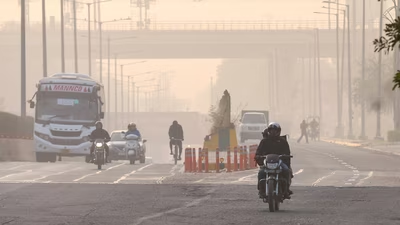
Delhi’s air quality remained in the ‘very poor’ category on Saturday morning, a day before Diwali, as a thick haze of pollutants enveloped the city.
Eighteen of the stations recorded air quality in the severe category. The bursting of firecrackers on Diwali and unfavourable meteorological conditions that limit the dispersion of pollutants could aggravate the situation. Farm fires in neighbouring Punjab and Haryana are also contributing to the seasonal pollution load. However, the figures may not be directly comparable, as the timing of stubble burning has shifted later in recent years.
The Air Quality Index (AQI) at 9.05 am stood at 364, according to data from the CPCB. At 53 of 59 air quality monitoring stations, PM 2.5 was the leading pollutant. The average AQI on Friday was on the brink of the severe category, at 382, prompting the CAQM to invoke GRAP III restrictions as a precautionary measure. NASA satellites detected 2,624 farm fires in Punjab and Haryana between October 1 and November 6, including 2,365 in Punjab and 259 in Haryana. Of these, 147 fires were detected on November 6. The count is lower than the 2,880 fires detected during the corresponding period last year. Nearly 98% of the fire heat recorded by Meteosat in 2025 occurred after 3pm, compared with 94% in 2024. Both seasonal counts are also likely to be underestimates, as much of the burning now takes place after the satellite passes over the region at around 1.45pm. The minimum temperature at Safdarjung, Delhi’s base weather station, was recorded at 16.2°C, 1.9 degrees above the seasonal normal. The minimum temperature at Palam stood at 16.5°C, while Lodhi Road and the Ridge recorded 16.7°C each. Ayanagar recorded a minimum of 16.6°C. Meanwhile, the IMD’s weather observations showed no rainfall at any of the five monitoring stations in Delhi-NCR in the 24 hours ending 8.30 am on Saturday. The maximum temperature at Safdarjung was recorded at 30.5°C on Friday, while Palam recorded 27.9°C.
The CPCB classifies an AQI between 0 and 50 as “good”, 51 and 100 as “satisfactory”, 101 and 200 as “moderate”, 201 and 300 as “poor”, 301 and 400 as “very poor”, and 401 and 500 as “severe”. The Air Quality Early Warning System has forecast that the air quality could slip into the severe category on Saturday and Sunday.
