
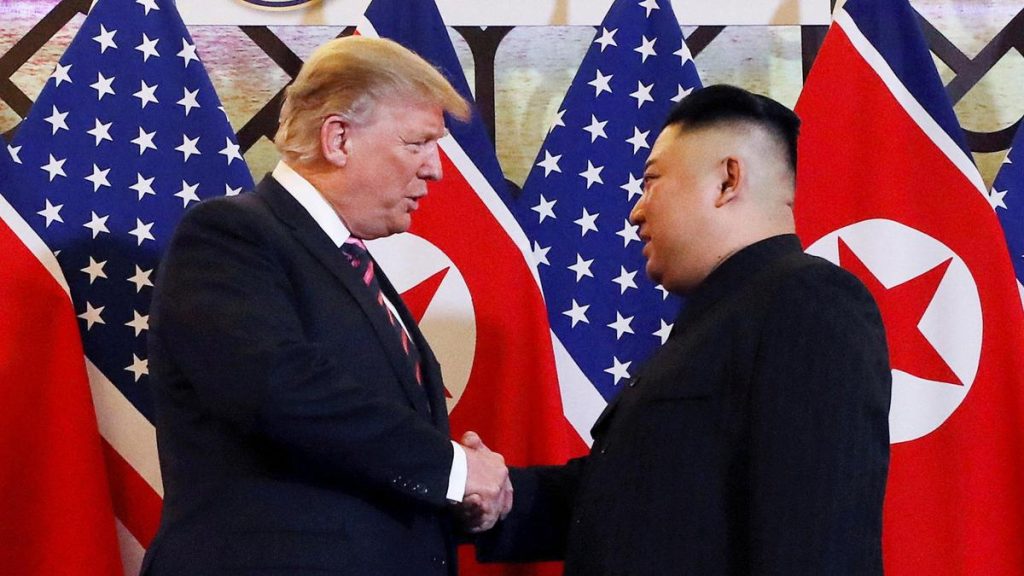
A meeting between Donald Trump and North Korean leader Kim Jong Un appears increasingly unlikely when the U.S. president travels to Asia in November, analysts say, after he suffered a crushing midterm election defeat.
Mr.
Trump had said he “may” meet Mr. Kim this month and that it “would be exciting”, but appeared to backtrack in October, saying, “I don’t know… I’m not sure that anybody’s asking for a meeting,” while adding that his “relationship with Kim Jong Un is very good.”
Mr. Trump’s focus on Mr. Kim and his scaling back of joint U.S.-South Korean military drills have alarmed Asian allies, while sparking speculation that he is seeking a foreign policy win as his war with Iran stalls. But Mr. Now, the dynamic has reversed. Trump is making repeated overtures, only to be met with reluctance from Pyongyang. Voters handed control of Congress to the Democrats in a stunning rebuke to Mr. Trump, leaving him as a lame duck President for the remaining two years of his term. “The Kim regime is looking for substantial and durable changes in US policy towards North Korea. Mr. Kim’s deepening ties with Russia and China have also strengthened his position and reduced his incentive to engage with Washington. Even if Mr. Trump and Mr. Kim agree to meet , their differences over North Korea’s nuclear weapons programme remain a major obstacle to any breakthrough. Pyongyang has repeatedly made clear it is no longer prepared to discuss denuclearisation. It came as South Korea’s dovish President Lee Jae Myung — who has repeatedly offered Pyongyang talks without preconditions — suggested Washington seek a freeze, rather than the immediate elimination, of the North’s nuclear programme and offer sanctions relief in return. That approach would face significant obstacles following Trump’s midterm defeat though, with Democrats committed to denuclearisation and Congress holding powers over sanctions relief. North Korea’s distrust of Washington, coupled with the uncertainty surrounding any agreement with Trump, could boost its nuclear ambitions. Pyongyang has carried out a flurry of weapons tests in recent weeks, including trials of cluster-bomb warheads, attack drones, a precision-guided torpedo system and an intermediate-range hypersonic missile.
In 2019, North Korea’s Kim Jong Un made a 60-hour train journey home from Hanoi empty-handed after a summit with Trump collapsed. Analysts say the North Korean leader has even less incentive to meet Trump after his Republican party suffered a thumping defeat in the U.S. midterm elections on November 3. Right now, nothing Trump offers comes with a guarantee that it will last beyond January 2029,” Bosack told AFP, referring to the date when the US president’s second term ends.
Kim’s powerful sister Kim Yo Jong signalled on Wednesday (November 4, 2026) that there was little appetite for renewed dialogue with Washington, saying Pyongyang had “no need to sit face to face with such unreliable and hostile persons”. “The choice for peace includes dialogue of course, but this is not surely equated with national interests for us,” she said. “The latest statement uses the (cyberattack) issue as an opportunity to condemn the entire US policy of pressure against North Korea,” he told AFP. “For Kim Jong Un, maintaining the status quo is the best option right now,” Lim said. But Washington’s “divided government and Trump’s lame-duck status will be an important variable for North Korea”. Pyongyang will be sceptical of Washington’s ability to deliver lasting concessions, said Michael Bosack, founding director of the Parley Policy Institute and a former UN Command official. North Korea’s economy grew more than three percent for a third straight year in 2025, Seoul’s central bank estimated in July, citing Pyongyang’s “expansion of economic cooperation with Russia” as its major driver. Kim Yo Jong said in September that the country’s nuclear-armed status was “absolute”, calling those hoping for denuclearisation “idiots”. “Pyongyang retains negative memories of failing to make progress in negotiations under the Biden administration because of its position that there would be no sanctions relief or dialogue without prior denuclearisation measures,” Kyungnam University’s Lim said. “North Korea’s belief that independently advancing its nuclear arsenal, regardless of changes in US administrations or political parties, was the right and strategically sound decision will be further reinforced,” Lim said. “The development, testing and training of new weapons will become regular and routine activities,” Lim predicted.
Ms. Ms.
Kim Yo Jong’s comments came after the FBI accused North Korea of a $6 billion heist from cryptocurrency exchange Binance — allegations she had previously slammed as “a grave political provocation”. Kim’s statement marked “a shift from defence to offence”, said Lim Eul-chul, a professor at Kyungnam University’s Institute for Far Eastern Studies in South Korea.
“Trump is expected to continue pursuing top-down dialogue with North Korea”, said Yang Moo-jin, former president of the South’s University of North Korean Studies.
