
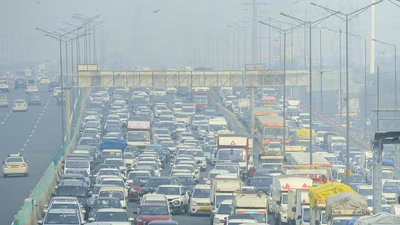
The Gurugram district administration has banned all dust-generating construction and demolition activities from November 5 to 20 and directed government and private offices to limit physical attendance to 50% as air pollution levels continue to rise.
The ban covers construction and demolition activities across the district, including work on highways, roads, flyovers, overbridges, pipelines and other linear public infrastructure projects. All dust-generating demolition and outdoor construction activities will remain suspended during this period. However, projects related to railways, metro services, airports, inter-state bus terminals, hospitals, water supply and sanitation, national security, defence and other projects of national importance have been exempted. These projects must continue to follow dust mitigation measures and comply with the Construction and Demolition Waste Management Rules.
Gurugram deputy commissioner Uttam Singh issued the orders on Tuesday in compliance with directions from the Commission for Air Quality Management (CAQM).
Industrial establishments and essential services where such an arrangement is not feasible have been exempted. To ensure compliance, the administration has directed sub-divisional magistrates (SDMs) and Haryana State Pollution Control Board officials to carry out daily inspections. Under the office attendance restrictions, Haryana government and private offices have been asked to ensure that no more than 50% of their staff attend workplaces physically, with the remaining employees working from home. Violations will invite action under the Commission for Air Quality Management Act, 2021. The restrictions will remain in force across Gurugram district until November 20 as authorities step up efforts to control dust emissions and improve air quality.
Gurugram’s air quality deteriorated to the ‘very poor’ category for the first time this season on Tuesday, with the Air Quality Index (AQI) touching 319. Among the city’s monitoring stations, Teri Gram recorded the highest AQI at 355, followed by Gwal Pahari at 340 and Sector 51 at 322. Vikas Sadan recorded an AQI of 257.
Three of the four monitoring stations in Gurugram reported ‘very poor’ air quality, highlighting the worsening pollution situation in the city.
