
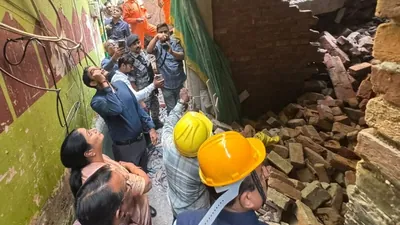
Delhi Police has arrested three contractors in connection with the collapse of an under-construction building in Old Delhi’s Chawri Bazar that killed two people and injured two others on Thursday, officials aware of the matter said on Friday.
Deputy commissioner of police (central) Rohit Rajbir Singh identified the accused as Siraj, Tajuddin and Furkan, all residents of the Ajmeri Gate area. Their full names were not immediately available. The collapse also exposed serious enforcement lapses. Fire personnel and other rescue teams had to rely largely on manual debris removal. Residents of neighbouring buildings were evacuated after police warned that one adjoining structure was in a precarious condition. Police are continuing their investigation into the construction activity and the circumstances leading to the collapse.
Police said the three men, who have been booked under Section 105 (culpable homicide not amounting to murder) of the Bharatiya Nyaya Sanhita (BNS), were arrested from Sirohi village in Faridabad’s Dauj tehsil. The building, a ground-plus-three-floor structure in Gali Sitara near Chawri Bazar Metro station, collapsed in two stages around 9.30am on Thursday. The lintel of the third floor reportedly gave way while concrete work was underway, followed by the collapse of the remaining floors within 15 to 20 minutes. Two workers, Kishori, 40, and Sanjeet, 45, died, while two others sustained injuries. In a letter dated June 15, the station house officer of Hauz Qazi police station had alerted the deputy commissioner of MCD’s City SP Zone about new residential construction spread over around 70 square yards at property number 4547-48 in Wali Sheesh Mahal, Ajmeri Gate, and sought action.
The arrests come amid questions over how construction continued at the site despite the building allegedly having no sanctioned plan and Delhi Police having alerted the Municipal Corporation of Delhi (MCD) about construction activity in the area nearly five months before the collapse. The rescue operation on Thursday was hampered by the extremely narrow lanes of the walled city, which prevented heavy machinery from reaching the site.
