
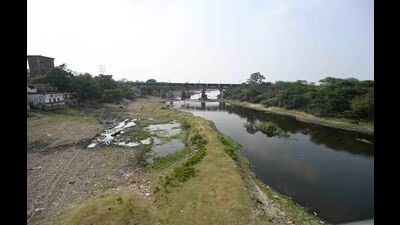
The future of the Gomti may lie not in the river itself but in nearly 10,000 ponds, lakes, wetlands and village water bodies spread across its basin. Once the lifeline of the river, many of these water bodies today stand encroached upon, silted or neglected. Environmental experts say restoring this forgotten network is the key to reviving one of Uttar Pradesh’s most important rivers.
Latest Update
Available estimates indicate that around 4,000 such ponds and lakes are located in Hardoi and Shahjahanpur, followed by nearly 2,000 each in Lakhimpur Kheri and Sitapur districts. Lucknow has around 1,344 ponds and lakes within the identified river corridor.
The Sarayan river, one of the Gomti’s major tributaries in Sitapur district, also has a substantial network of water bodies. Nearly 956 ponds and lakes are situated within two kilometres of the Sarayan, highlighting the importance of tributary catchments in strengthening the Gomti basin.
Pilibhit district magistrate Gyanendra Singh said the district administration has launched an integrated rural development initiative covering 16 gram panchayats along a 47-km stretch of the Gomti to strengthen water conservation, green cover and community participation.
He said the focus is on keeping the Gomti “Sadaneera” (perennial) through the rejuvenation of local water bodies under the Mahatma Gandhi National Rural Employment Guarantee Scheme (MGNREGS), with special emphasis on pond restoration, groundwater recharge and sustainable rural infrastructure.
As part of the initiative, around 40 ponds across the selected gram panchayats will be renovated and recharged under the Mahatma Gandhi National Rural Employment Guarantee Scheme along the 47-km stretch of the river. Singh said a large-scale plantation drive will also be undertaken along both sides of roads in the river corridor during the monsoon. The administration plans to develop single-species green corridors in consultation with environmental experts to improve survival rates and maintain ecological balance.
He said the district is also implementing a ‘One Ghat per Gram Panchayat’ initiative under which every gram panchayat will have a developed ghat equipped with solar lighting. The project aims to create cleaner public spaces, improve night-time accessibility and strengthen the community’s connection with the river.
Community participation through ‘Gomti Mitras’
To strengthen local participation, the administration will deploy around 100 ‘Gomti Mitra’ volunteers who will help maintain ponds, support plantation drives and encourage public involvement in conservation activities.
Officials said the initiative aligns with the broader objectives of rural transformation and sustainable development under the Viksit Bharat mission and other convergence-based government programmes.
Lucknow mayor Sushma Kharakwal said the municipal corporation is focusing on water conservation, afforestation, renewable energy through solar lighting and community ownership to ensure long-term sustainability rather than short-term infrastructure creation along the Gomti.
“I have already written seeking the cleaning of the Gomti and stopping the direct discharge of drains into the river,” she said.
Details
These traditional water bodies, located within a two-kilometre ecological radius of the Gomti and its tributaries, once functioned as a finely balanced hydrological system. They stored monsoon rain, recharged groundwater, reduced floods and sustained the river’s base flow during dry months. Today, encroachment, silt accumulation and neglect have disrupted the natural chain that once kept the river perennial.
However, this network has weakened over decades of land-use change. Encroachment, urbanisation, indiscriminate dumping of solid waste and declining community stewardship have reduced many ponds to fragmented or seasonal water bodies, sharply diminishing their role as groundwater recharge zones.
Environmental assessments cited by experts indicate that river flow across the Gomti basin—from Pilibhit through central Uttar Pradesh to Lucknow—has declined by nearly 40% over the past four decades due to shrinking wetlands, excessive groundwater extraction and the loss of floodplain connectivity.
Professor Venkatesh Dutta of the School of Earth & Environmental Sciences (SEES), Babasaheb Bhimrao Ambedkar University (BBAU), said the Gomti’s revival requires a basin-wide ecological approach that treats ponds, wetlands and tributaries as one interconnected system rather than isolated water bodies.
He called for scientific mapping of all ponds and wetlands, removal of encroachments, desilting, catchment treatment and active community participation in conservation. Equally important, he said, is strengthening sewage treatment infrastructure by ensuring the efficient functioning of sewage treatment plants (STPs), installing interception screens at drain outlets and preventing untreated sewage and solid waste from entering the river.
Dutta also cautioned against large riverfront-style projects involving excessive concretisation that alter the river’s natural floodplain. While such interventions may improve the river’s appearance, he said, they often weaken its ecological resilience. Instead, he advocated restoring natural floodplains and hydrological systems to revive the river sustainably.
source
Environmentalists warn that unless immediate steps are taken to restore wetlands, remove encroachments, improve sewage treatment, regulate groundwater extraction and revive traditional water bodies, the Gomti—an important source of water for millions of people—could face an even deeper ecological and water crisis in the years ahead.
Pilibhit adopts basin-level conservation model
