
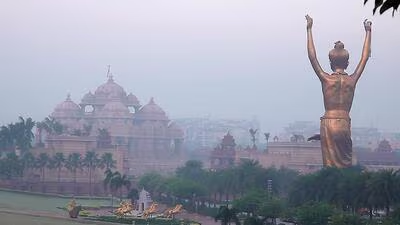
Very light to light rain was expected in parts of Delhi, even as the minimum temperature of 19.2°C at Safdarjung, the city’s base weather station, on Thursday was 3.1 degrees above normal, and three monitoring stations recorded very poor air quality. The overall Air Quality Index (AQI) was in the poor category (228) at 9.05am. Nineteen monitoring stations recorded moderate air quality.
In its 8.30am weather bulletin, the India Meteorological Department (IMD) said the minimum temperature at Safdarjung rose by 3.5 degrees in the past 24 hours. On Wednesday, Delhi recorded a maximum temperature of 31.8°C, 0.8 degrees above normal. On Thursday, Palam recorded a minimum temperature of 17.7°C, 0.7 degrees above normal. Lodhi Road registered 18.4°C, 3.4 degrees above normal. The Ridge recorded a minimum of 19°C, 1.7 degrees above normal. Ayanagar was the coolest among the five stations, with a minimum temperature of 17.4°C, 1.1 degrees above normal. At 6am, the Central Pollution Control Board (CPCB) listed PM2.5, microscopic fine particles with a diameter of 2.5 micrometers or less from direct combustion emissions or through chemical reactions in the atmosphere, as the main pollutant at 40 of Delhi’s 58 reporting stations, and PM10 at 18. At the same hour a day earlier, the counts were 42 and 15, out of 58. PM2.5 is the dominant pollutant affecting air quality. As many as 98% of the fire heat Meteosat, a European weather satellite that scans the region every 15 minutes, recorded in 2025 came after 3pm, against 94% in 2024.
Because most of the burning now happens after the satellite passes at about 1.30pm, both are undercounts. Air quality in Delhi and the National Capital Region (NCR) starts worsening from mid-September. Stubble burning acts as a precursor to winter pollution. Smog chokes the Capital every winter. Subsequent fireworks during the festive season, especially around Diwali, worsen the situation despite curbs, which are violated every year. Secondary particulates formed from emissions from transport, industries, power plants, and biomass burning are among the major pollution contributors during winter. The counts can differ for that reason alone.
