
17-year-old Jessica (name changed) came from Manipur, where she had completed Class 12 but could not sit her final examinations. When she arrived in Israel in April 2026, she began learning the language she would need to continue her studies and build a life in a country very different from the one she had left behind. On one hand, it was her dream come true, but on the other, it was the challenge of adapting to several new things at the same time. Learning Hebrew perfectly was one of them.
The community identifies itself as descended from the biblical Tribe of Manasseh, one of the so-called lost tribes of Israel. She was not alone. For thousands of members of the Bnei Menashe community in Manipur and Mizoram, migration to Israel promises a fresh start. But between the decision to leave and the prospect of a settled life lie several hurdles, including religious recognition, language lessons, interrupted education and the search for work. For young people, in particular, learning Hebrew can make the difference between simply settling in Israel and finding a way to move forward. “Its members have practised forms of orthodox Judaism for generations, and Israel has facilitated their immigration through a process involving religious recognition and conversion. Once the tribal people land here in Israel, they get their training in Hebrew from Ulpan Ivrit. After completion of the course, certificates are given, which further helps them to fetch a job in the holy land of Israel. The scale of the proposed migration raises an important question: what happens after these families arrive? For many, the answer will depend on how quickly they can learn the language, continue their education and find their place in Israeli society. Jessica’s immediate priority is to continue her education. She was living at an absorption centre in Nof HaGalil and attending Hebrew lessons after arriving in Israel. She hopes to complete her studies and eventually undertake national service. For now, learning the language is an essential step towards those ambitions. “The challenge is easy to underestimate. In everyday printed texts, vowels are generally omitted, making unfamiliar words harder for beginners to read until they become familiar with their spelling and pronunciation. For a student who has spent years studying in another language, the transition can be demanding. Understanding a lesson is one thing; answering a teacher confidently, writing an examination or following a fast-moving classroom discussion is another. For students such as Jessica, the stakes are higher than simply learning to converse. Hebrew is also the language through which they must navigate the education system and prepare for their next academic step. Addressing the challenges Jessica mentioned, “The crucial question is whether the opportunities offered during resettlement will enable newcomers to become independent over time. “A student arriving from India may already understand mathematics, science, or history well. An answer that comes easily in a familiar language may be difficult to express in Hebrew. For teenagers whose schooling has been interrupted, the adjustment can be particularly difficult. They may have to establish their academic standing, understand unfamiliar examination requirements, and work out which courses they can pursue. Jessica’s experience is a reminder that migration does not automatically translate into better educational outcomes. The opportunities may be there, but students need the language skills and institutional support to access them. “There is also a social side to learning. A child who cannot follow conversations among classmates may find it harder to make friends or feel at home in school. They help newcomers take part in the ordinary exchanges through which people become familiar with a new place. Her work has included teaching Hebrew in different universities and at absorption centres in Israel. She has also developed learning materials, including Hebrew–Kuki and Hebrew–Mizo dictionaries, for students from the community. The idea behind such resources is straightforward: learning becomes easier when students can connect unfamiliar words with a language they already understand. For Bnei Menashe learners, Kuki or Mizo can provide a starting point for understanding Hebrew vocabulary and expressions. In an interview while addressing International students in Israel, Amit reflected on the experience of working with the community. She emphasised the importance of listening to students and understanding their cultural backgrounds rather than assuming that one teaching method will work for everyone. Cohen described her own role as extending beyond that of a teacher.
Dayanim are the Jewish court of law who looks after Bnei Menashe,” said Avielah Bat Menashe, who came to Israel in 2013 is presently working as a Ballanit in a mikveh. Avielah wants her 31-year-old daughter, currently residing in Delhi, to move to Israel for work and a better lifestyle. In November 2025, the Israeli government approved a plan to bring approximately 5,800 remaining members of the community to Israel by 2030. The first phase envisaged the arrival of 1,200 people by the end of 2026, with further groups expected to follow over the next four years. “First week of November 2026 will be the last interview taking place. Hebrew is written from right to left, unlike English, and uses an alphabet of 22 letters. Amit Cohen, a Hebrew teacher who has worked with Bnei Menashe students since 2012, has learnt that teaching newcomers requires an understanding of the languages and experiences they bring with them.
Language lessons therefore serve a purpose beyond the classroom.
she said, “We already followed Shabbat in India While explaining that the language programmes and kibbutzim provide learning opportunities can help people prepare for work. I am looking for a Rabbi from Delhi to help me with recommendation,” Avielah said. The language also has its own grammatical structures and verb patterns,” Jessica said. Progress varies according to age, previous language experience, the intensity of instruction and opportunities to practise outside the classroom. Yet demonstrating that knowledge in a new language can take considerably longer,” Jessica said, demonstrating the problems she faced. She said, “Instructions may need to be read twice. For adults, limited Hebrew can make routine interactions with officials, employers and neighbours uncomfortable,” said Avielah who had experienced such challenges. “Instead of approaching every new word without a reference, they can use their existing language skills to make sense of what they are learning,” Cohen said. “To be successful in working with immigrants it is very important to get to know their unique culture, to listen to them, learn from them, come from a place of modesty and of course open your heart,” she said. “When I am with the Bnei Menashe, it is important for me to be not only a teacher but also a student,” she said.
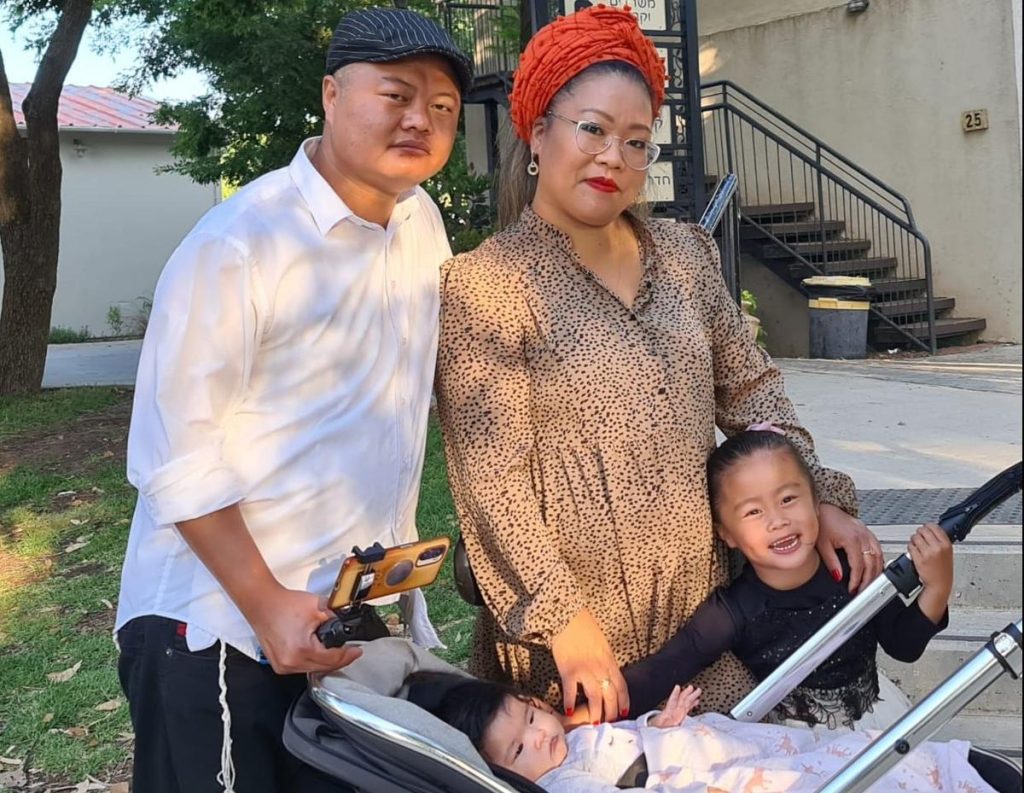
Her approach points to an important part of language education that can easily be overlooked. Students do not arrive without knowledge or experience. They bring their own languages, family histories and ways of learning. Recognising these can help teachers build a more effective bridge to Hebrew. Esther Kolnoy grew up in Mizoram as a member of the Bnei Menashe community. Her childhood was marked by hostility from some other children, who teased her for being Jewish and mocked her religious beliefs. She had to adjust to a new school environment while learning Hebrew and attending religious conversion classes. Esther Kolnoy with her family in Israel. Photo credit: Special arrangement “Adapting to a new country, learning an unfamiliar language and meeting educational and religious requirements. Kolnoy eventually became the first Bnei Menashe social worker in Israel. Her journey offers a glimpse of what can become possible when newcomers find a way through the initial difficulties. It does not mean that every migrant will have the same experience, but it demonstrates why support during the early years can matter long after the first language course ends. Reaching that point, however, requires more than determination. Students also need opportunities to continue their studies and gain qualifications that employers recognise. In parts of Manipur and Mizoram, families have depended on farming and informal work. The prolonged ethnic conflict in Manipur has made life particularly difficult for people in affected areas, with schools and normal routines disrupted. The longer-term outcome will depend on whether families can settle securely, students can continue their education and adults can establish sustainable livelihoods. The migration also has a political dimension. Israel’s immigration policies are closely linked to its Jewish identity, and the arrival of thousands of new residents could contribute to population growth and the development of communities in the country’s north. As Bnei Menashe members obtain citizenship and become eligible to vote, they may eventually participate in Israeli elections. Their religious background is orthodox Judaism. Access to education and employment can shape whether newcomers feel included in society and how they view its institutions. He acknowledged that questions about the community’s origins and identity had prompted scepticism in some quarters, even as the Israeli government facilitated its immigration. His final wish was for peace for civilians, a secure future for students, and harmony among communities and organisations. A parent must still find work. A family must still learn how to belong. Hebrew lessons may begin that process, but the real measure of success will be what the community can build with the opportunities that follow.”
In 1999, when she was 15, Kolnoy moved to Israel with her parents and two siblings. In this situation, the Israeli government’s plan to relocate approximately 5,800 remaining community members to Israel by 2030 will therefore need to be judged on more than the number of arrivals.
Back then, it was not easy for a teenage girl,” she said. Daniel Thong, chairman of the JO Foundation, an NGO working for children with disabilities, said, “For young Bnei Menashe migrants, education can provide a route into professional life. “Both the Meitei and Naga communities in Mizoram and the surrounding regions have felt the impact,” Daniel Thong said, adding that restoring normalcy and ensuring uninterrupted learning could take several years. Thong said many Bnei Menashe appeared to be settling into life in Israel, with some also serving in the Israeli military. He said, “A student must still learn to read a textbook, understand a teacher, and sit an examination.
