
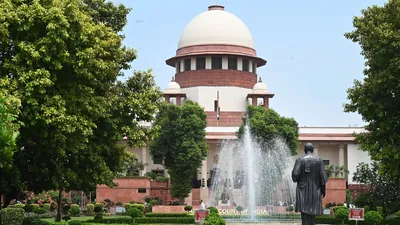
The Supreme Court on Tuesday regretted the “policy deficit” in evolving a national consensus on compulsory rural service by medical students, indicating that it may lay down constitutional principles to guide states in framing regulations to ensure doctors serve the country’s underserved rural population.
She said health was a state subject and several states had introduced bonds requiring doctors to serve after completing their medical education. The court asked the Union government to clarify whether it intended to formulate a national policy and whom it proposed to consult before taking a decision. “What is suggested is not a mandate. As a matter of principle, are the policy makers and constitutional requirements in sync with that principle that rural service across India for our doctors is a necessary measure or not for betterment of our health and national health? That is the short issue,” observed the bench. Bhati also informed the court that a committee had recommended the uniform adoption of such bonds by states. However, the Union government indicated that it could undertake a consultative exercise rather than have the court issue a direction that could affect medical institutions across the country. At this, the bench emphasised that the court was examining the constitutional principle underlying compulsory rural service, rather than seeking to prescribe a uniform mechanism for its implementation. The modalities, including whether the requirement should be enforced through bonds or regulations, could be worked out separately, it added. “We will formulate the constitutional requirement of it just as a guiding principle. The court posted the matter for hearing next week and asked the Centre to clarify whether it proposed to formulate a policy and identify the stakeholders it intended to consult.
Senior advocate Raju Ramachandran, assisting the court as amicus curiae, suggested that the court lay down appropriate guidelines to address the legislative gaps, drawing upon Article 21, which guarantees the right to life, and the Directive Principles of State Policy.
A bench of justices PS Narasimha and Alok Aradhe said that the issue went beyond the validity of a Karnataka government notification requiring medical graduates to undertake one year of compulsory public service, stressing that the policy would have a bearing on the future of healthcare delivery in India. The bench said it could lay down guiding principles based on the constitutional obligation to protect the right to health , leaving it to states to work out the appropriate regulatory framework in consultation with the relevant medical authorities. The court said that the government needed to reflect on the issue at the policy-making level, adding that the constitutional interpretation of the right to health as a fundamental right and the corresponding obligations of the state could provide the basis for examining the need for compulsory rural service. “In times to come, where access to hospitals will virtually be access to hospitals run by private institutions, moving away from catering to the needs of the rural areas is something to be assessed as a matter of constitutional principle,” said the bench, flagging the implications of healthcare delivery increasingly involving private institutions. The observations came after additional solicitor general Aishwarya Bhati told the bench that while postgraduate medical students were subject to compulsory service requirements on a rotational basis, there was no corresponding national requirement at the undergraduate level. The formulations will be by the state in consultation with the National Medical Commission ,” said the court, indicating the approach the bench was considering.
the court had flagged the need to address rigid and varying conditions imposed by states and suggested that the Union government and the Medical Council of India consider a uniform policy for compulsory service by doctors trained in government institutions While recognising the validity of such requirements. The dispute also draws upon the Supreme Court’s 2019 decision in Association of Medical Super Speciality Aspirants and Residents Vs Union of India, in which the court upheld compulsory bonds imposed on candidates seeking admission to postgraduate and super-speciality medical courses.
The case arises from a challenge to the Karnataka Compulsory Service Training by Candidates Completed Medical Courses Act, 2012, and the rules framed under it in 2015. A notification issued on July 28, 2023, extended the requirement to students enrolled in private seats in private and deemed universities. The petitioners have challenged this extension, arguing that students who pay substantially higher fees for private seats constitute a distinct class under Article 14 of the Constitution and should not be subjected to the same compulsory service conditions.
The law requires MBBS graduates, postgraduate diploma and degree holders, and super-speciality candidates who have pursued their courses in government institutions or secured government seats in private or deemed universities to undertake one year of compulsory public rural service. Completion of the service requirement is necessary for obtaining a no-objection certificate, which enables candidates to secure permanent registration with the Karnataka Medical Council. They have sought directions to the Karnataka health authorities to issue the requisite NOC without insisting on an undertaking for compulsory rural service and to the state medical council to grant them permanent registration.
