
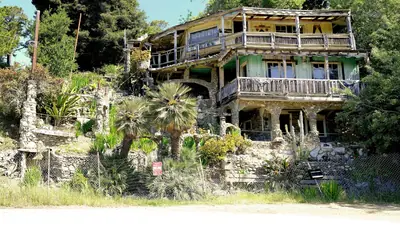
In 1928, he bought two and a half acres of pine-covered hillside in Cambria Pines, California, and began building a home from salvaged objects. The project continued for more than 50 years and eventually spread across a 250-foot-high ridge, according to the SPACES Archives profile of the site . Most people see the city dump as the place where broken things go to die. Art Beal saw a source of building materials. The result, Nitt Witt Ridge, became one of California’s unusual examples of folk art architecture.
Beal operated under a simple rule: pay for cement and salvage the rest. He gathered shells from the sea, wood from the hillsides, discarded household items, and other materials from the dump. As Cambria’s garbage collector, he had regular access to objects that others threw away. Local accounts suggest that his interest in salvaging materials eventually became so consuming that it affected his work at the city dump. Beal also worked hauling materials to William Randolph Hearst’s estate at Hearst Castle in San Simeon, north of Cambria. Local accounts recorded by SPACES Archives suggest that discarded materials from the estate found their way into his hillside structures. The work gave Beal access to a variety of building supplies and decorative objects, which he incorporated into a home shaped by the terrain and the materials he could obtain. Nitt Witt Ridge remains a record of Beal’s decades-long effort to turn discarded materials into a home. Its terraces, irregular walls, and winding pathways reflect the way he adapted construction to the hillside and built with whatever he could salvage.
Beal lived at Nitt Witt Ridge until 1989, when he moved to a nursing home. He died in 1992. A young couple bought the property in 1999 and began restoring it, repairing staircases, walls, and sections of the foundation while clearing overgrown vegetation.
