
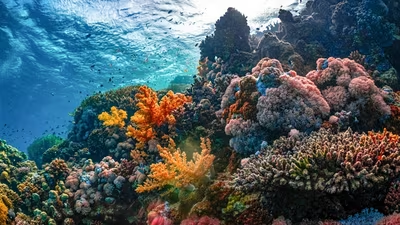
Where does the carbon dioxide from our cars and power plants go? Part of it ends up in the ocean, and scientists wanted to know what that does to a coral reef. They bubbled carbon dioxide into a tank of seawater, pumped it onto the reef, and allowed it to flow across. The water was made as acidic as it is projected to become by the end of this century if emissions continue unchecked. The reef built up calcium carbonate more slowly.
A team of researchers led by Rebecca Albright and Ken Caldeira tested this on Australia’s Great Barrier Reef, according to a California Academy of Sciences press release.
Many previous studies have mainly concentrated on single species or single organisms. This one aimed bigger. The team worked on the reef flats surrounding One Tree Island, a small coral cay in the southern Great Barrier Reef . By studying the whole community, researchers can understand how acidification impacts the ecosystem and the coastal communities that rely on it. They also put in a dye to track where the water went. They then measured net community calcification, the amount of calcium carbonate reef organisms deposit to build their skeletons. Even if you live far from the coast, reefs still affect people in many ways. Reefs feed millions of people, protect coastlines, and generate billions of dollars a year in tourism, the Nature paper notes. Caldeira also pointed to fishing and tourism as sources of income for nearby communities. Cutting emissions is something we can still work on.
The 2018 study by Albright and colleagues, published in Nature , describes a simple routine. The experiment was conducted once a day for 30 days in 2016. On 20 of those days, the team bubbled carbon dioxide into a tank of seawater, pumped it onto the reef, and allowed it to flow over the reef. For the other 10 days, they ran the same setup with no extra carbon dioxide to provide a fair comparison.
Because reefs are complex communities of corals, algae, and other organisms, that matters. Because this study only looked at one reef flat, the results don’t mean every reef will respond the same way. There is also the added danger of warming due to climate change.
It was the first ocean acidification experiment where researchers added carbon dioxide to seawater to make it acidic and then let it flow across a natural reef community, the press release said. But Albright said the findings are strong evidence that acidification will severely slow reef growth in the future unless greenhouse gas emissions are cut steeply and rapidly.
That’s roughly a third less. They say this is, to their knowledge, the first community-level estimate of this type from a controlled experiment in a natural setting. In that study, the team made seawater less acidic, and the corals’ ability to build their skeletons improved.
The paper says that net community calcification was 34% lower on the days with added carbon dioxide. The authors also mentioned a statistically significant decrease in calcification on each of the 20 experimental days. This is consistent with a 2016 study by Albright and Caldeira.
That earlier study found evidence that acidification is already reducing reef calcification.
