
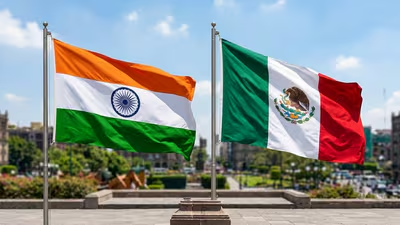
India and Mexico will sign terms of reference this week to formally launch negotiations for a free trade deal, aiming to shield exports of Indian automobiles, textiles, footwear, plastic, steel, chemicals and toys from recently-imposed high tariffs in the Mexican market, officials familiar with the details said.
The two sides will formally sign the ToR in the next couple of days as commerce secretary Rajesh Agrawal is visiting Mexico from Monday, they said, asking not to be named. Both India and Mexico h ave already finalised terms of reference (ToR) for a preferential trade agreement (PTA). Agrawal is on a week-long trade mission covering Mexico and Brussels, headquarters of the European Union.
Out of total $5.73 billion Indian merchandise exports to Mexico in 2025-26, automobiles constituted the single largest segment at $1.92 billion, according to the government trade data. Effective from January 1, the decree pertained to the Mexico Plan to increase the national content in production chains by 15% by 2030. Launched in January 2025, the plan aims to make Mexico the top 10 economy by 2030, revive local industries, and create 1.5 million jobs. Bilateral merchandise trade between India and Mexico stood at around $7.83 billion in 2025-26, according to government data. India exported goods worth about $5.73 billion to Mexico and imported merchandise worth $2.1 billion in FY26, according to data.
Experts said the ToR is the first step towards shielding Indian exporters from high tariffs in Mexico, particularly Indian automobile exports to the country. The identified items include goods such as automobiles, textiles, clothing, plastic, steel, household appliances, aluminium, toys, furniture, footwear, leather goods, paper and cardboard, motorcycles, trailers, and glass products. Key Indian merchandise exported to Mexico, included automobiles and auto parts, pharmaceuticals, engineering goods and chemical products. On the other hand, Mexico mainly supplied crude oil, which accounted for almost three-fourths of its total exports to India. Other products of export to India are gold and related jewellery, and chemical compounds.
The proposed India-Mexico PTA is expected to shield Indian exporters from high tariffs up to 50% imposed by the Mexican government on 1,463 items on imports from countries with which it does not have any bilateral deal such as a PTA or a free trade agreement (FTA).
Experts said it is prudent to negotiate a bilateral PTA quickly to protect Indian exports from higher tariffs instead of going for a comprehensive FTA, which will take relatively more time. An official said the proposed PTA is expected to focus only on preferential trade in goods. A PTA is limited in scope and provides a positive list of items where tariffs are usually reduced and rarely brought to zero. An FTA is a comprehensive agreement aiming to eliminate tariffs on a vast range of items while keeping a negative list of items.
