
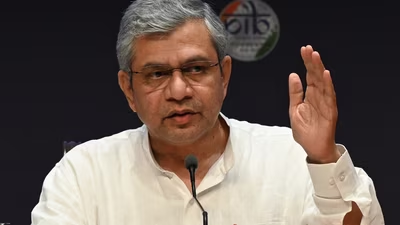
Union minister for railways, information and broadcasting, and electronics and information technology Ashwini Vaishnaw on Friday said the government will issue a consultation paper on a new Artificial Intelligence (AI) law “in coming weeks”, saying the risks from the technology have crossed a “threshold” that now demands legislation.
“We should come up with a new regulation where the harms from the new technology can be regulated. The remarks mark a visible shift in the government’s public stance. A consultation paper will be the first formal step towards a statute. Vaishnaw, a BJP leader, did not say when a bill could reach Parliament, and he gave no details on its scope, the regulator or penalties. One argues that the technology should evolve sufficiently before it is regulated.
The IT ministry’s India AI Governance Guidelines, released on November 5, 2025, called for focused amendments to existing laws instead of a standalone AI statute. The ministry’s secretary S Krishnan said in December 2025 that no dedicated AI law was being planned, and a 2023 parliamentary reply under Vaishnaw said the government was not considering a law to regulate AI’s growth. Because the government has so far argued that existing laws and voluntary norms are enough, a position that critics said left gaps on risks such as autonomous agents and accountability, the shift matters.
Speaking at the NDTV World Summit in Delhi, Vaishnaw said the proposed regulation will target the harms of AI while keeping humans in control of the technology. “Today the time has come when the risks of AI have crossed a threshold when we should come up with a law,” Vaishnaw said. Having said that, we are already working on it. Vaishnaw said that two schools of thought on AI exist globally. The other, which he described as the European approach, is to “swat” every innovation early, a style he said stifles growth.
The line suggests the proposed law will be framed as a harm-based regulation and not a licensing regime, though the government has not spelt out the design.
“Our bias has always been towards more towards innovation,” Vaishnaw said, adding that the state must “simultaneously” keep citizens safe.
The minister argued that no single country can write rules for a borderless technology. He pointed to the nuclear industry, where countries sat together and agreed on principles that now govern the sector, as the template for AI. Some principles, he added, are already established. The remarks echo concerns about AI agents acting without oversight, though he did not say how such a stopping mechanism will be mandated or who will hold the switch. Those questions are likely to be central to the consultation.
“In the digital world, the physical boundaries do not exist,” he said, adding that any initiative “has to be globally aligned”. Vaishnaw said India will sit at that table as one of the “top three or top four AI ecosystems in the world”, along with the other global giants. The race towards innovation, he said, “has to be moderated by safety of human beings”. Those principles, in his words, are that AI “has to be human first” and “humancentric”. Control over the agents, the models, the outcomes and the processes “has to be in human hands”, he said, and there must be “some equivalent of stopping things if they go out of control”.
“Now we need to discuss with the stakeholders who are users of AI. The shift in focus from developers to users is significant, since sectors such as banking and insurance are where AI errors can hit citizens directly.
On process, Vaishnaw said the paper will seek inputs from civil society, citizens, industry and other stakeholders. Banks, manufacturers, insurers and service firms are adopting AI rapidly, he said, so there is “a good understanding” of what the technology can deliver and what harm it can do. “We have discussed a lot with the tech companies,” he said.
