
Every day, for six months last year, Julie Elie walked into her lab with one goal: to eavesdrop on her birds.
In one key finding, for instance, using machine learning to help analyse the birds’ chatter and associated behaviour, she and her team revealed a groundbreaking aspect of communication in this species: zebra finches confuse calls with similar meanings more than they confuse calls that sound the same. Elie started out, as many bioacoustics researchers do, trying to understand the structures and methods animals use to communicate, as part of the larger effort to decode such communication. Her work, however, is thought to represent a significant leap. This means they aren’t registering sound alone, when they listen; they are also registering meaning. What it tells us about zebra finch cognition is significant. “For instance, when aggressing one another, it makes an ‘ah!’ sound. When calling to a partner, it’s closer to ‘eh!’. Other physical behaviours that correlated to calls ranges from a bird defending a nest to searching for a partner, or even begging for food. There were calls for hunger, danger, hello. There was a sort of Marco! There is a distress signal, used by a bird to indicate it needs help from the flock. It helps that they occupy a sweet spot among species, in that they are (rather sadly) comfortable with captivity, happy in an environment that offers them comfort and the company of other zebra finches. “Some animals only produce two call types. Others produce a far larger number. Crows, for instance, have such a diversity of sounds that they vary based even on whether they are in a group or not. That makes it very difficult, at the level of knowledge we have right now worldwide, to parse the building blocks of their language. With the zebra finch, we have manageable diversity: about a dozen calls they use to communicate with each other, that we know of. FIRST, THE PLAYLIST So, how did her landmark finding come about? At first, it seemed almost too good to be true. Were she and her team projecting human patterns onto these creatures? To verify their findings, Elie turned to the birds themselves, in a sense, for validation. And this is another part of what makes her research remarkable. In a controlled environment, the finches were given a button to press to generate an audio recording. The recordings were typically a series of zebra finch calls, played one after another in a random series. Each day, the researchers picked a different call as a reward trigger. If the bird tapped until it came to that sound and waited for it to play all the way through, it was rewarded with seeds to eat. Soon enough, the birds were pecking at the button, pausing at the specific sound, getting their seeds as a reward. Except, sometimes, they were confusing a different sound for the sound of the day. And it turned out the calls that most often triggered these mistakes weren’t ones that sounded like the call of the day; but ones that meant a similar thing. SKIPPING TRACKS? That wasn’t all. The zebra finches began to, sort of… scroll.
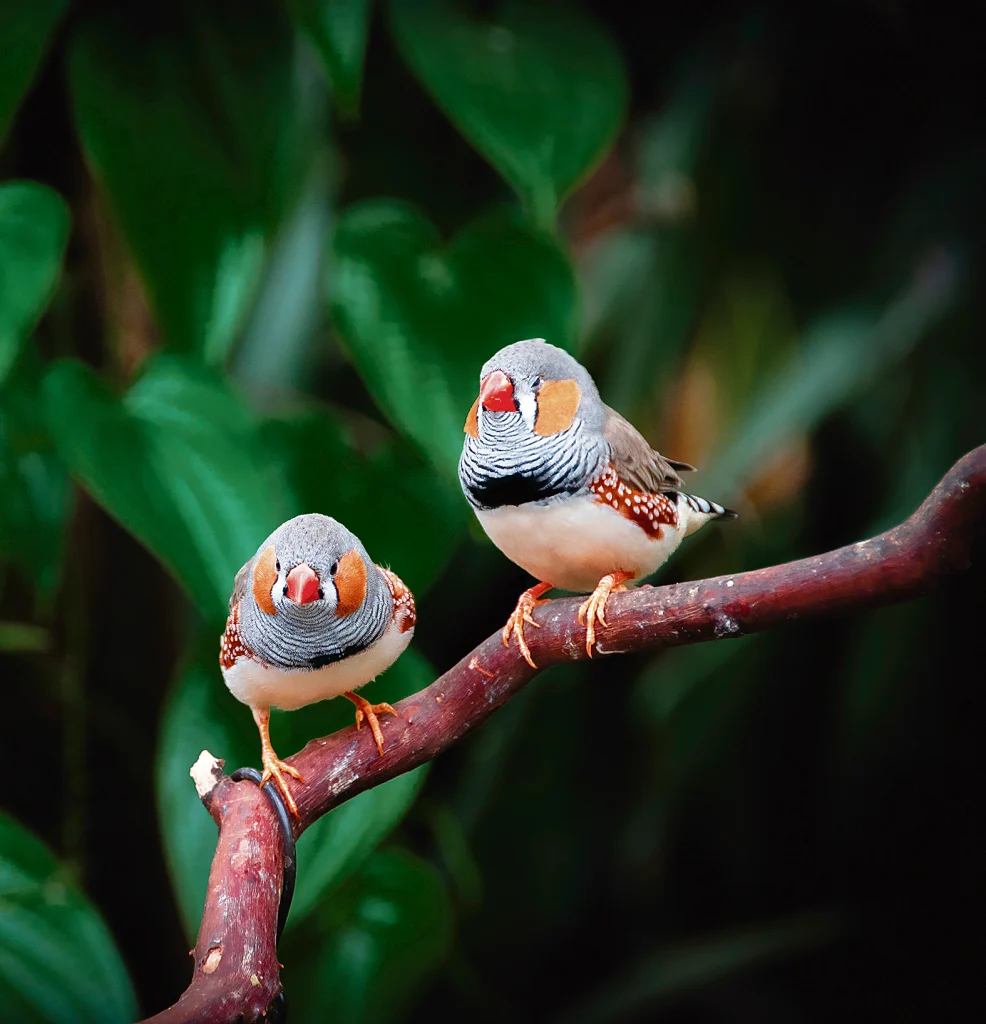
Her work with the chatty, picturesque little zebra finch has now earned her the $100,000 Coller-Dolittle Prize for progress in interspecies communication. Elie has been studying this bird since her days as an undergraduate student at Ecole Normale Superieure de Lyon (ENS de Lyon) in 2004. As a postdoctoral fellow at the Helen Wills Neuroscience Institute from 2010 to 2017, she focused on neural coding of meaning in the avian auditory system. By the time she joined the Theunissen Lab at University of California, Berkeley, in December 2024, patterns had started to emerge. By September last year, having observed the rather chaotic chatter daily of the birds, Elie and her team had identified 11 core call types or vocalisation categories. These chatty little creatures have long been considered wonderful test subjects for animal communication, and have been studied by researchers in this field for at least 30 years.
Professor Yossi Yovel, a zoologist at Tel Aviv University and chair of the panel of judges, has called her findings “a key moment in the field”. “I found a correlation between certain types of sound and certain types of behaviour,” she says. This was the first step in attaching “meaning” to a sound. Polo! call for birds trying to place each other in a landscape; another for those simply calling out “I’m here”, hoping to hear a response in acknowledgement. These birds also use “distance” calls, when moving through dense environments; during flight or foraging, these help a flock stay together. CALL LOGS The fact that zebra finches have been studied extensively in the past meant that there was a hefty body of knowledge available, and that helped too, Elie says. “They sit at this nice little level of complexity that makes it interesting,” Elie says. A human equivalent would be mixing up “here” and “I’m present”, instead of, say, “here” and “ear”. “The way they confused calls was revelatory,” Elie says.
When they hit upon a call that wasn’t the reward call of the day, they pecked again, impatiently, to get to the next one and the next one. They were skipping the tracks with no reward. Elie is now working with her team to detect more vocalisations in the zebra finch. It’s been a dream for centuries, she adds: understanding the sounds we hear in the wild. “Humans are such an invasive species around the world. Maybe this could be a key to learning to coexist peacefully.”
“I’m working to apply AI-led large language models to the question of how many calls they have in all, and how best to classify them,” she says. “If we can understand them better, maybe we will be able to respect them better,” Elie says.
