
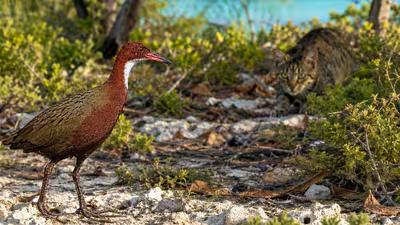
In a 2013 study published in the journal Conservation Evidence Šúr, van de Crommenacker and Bunbury examined the return of that bird, the Aldabra rail, to Picard Island. It began with 18 birds and a reintroduction plan that exceeded scientists’ expectations. A bird that cannot fly has one big problem when a predator shows up: nowhere to go. On Aldabra Atoll in Seychelles, that predator was cats, and they were the main reason a flightless bird vanished from two of the atoll’s islands.
This was one species on one island, and the cats had to go first. The study also offers a reliable way to count rails and recommends continued monitoring and conservation management. For a bird that can’t fly away from trouble, Picard became a true second chance.
Scientists had predicted that Picard could hold about 1,000 pairs of rails by 2010, which they saw as the island’s limit. A follow-up survey 12 years after the release, one year after the predicted population peak, confirmed that Picard had reached that limit and likely surpassed it. It found about 1,106 territorial pairs, roughly 10% more than predicted, plus an estimated 553 non-breeding adults, or about 2,765 birds in all. By 2012, the Seychelles Islands Foundation, which manages Aldabra, estimated the population at close to 3,000 birds. That’s a big jump from 18, but not every reintroduction will be like this.
Šúr and colleagues describe the Aldabra rail as the last surviving flightless bird in the Indian Ocean. In both cases, the main culprit was feral cats brought in by early settlers. That left the entire wild population confined to three islands of a single atoll.
The study suggests that the rail disappeared from Grande Terre before the late 1800s and from Picard shortly after 1910. By 1998, the rail existed on only three of the atoll’s islands, and Picard was not among them. Because a flightless bird has no quick way out, cats were a serious threat.
