
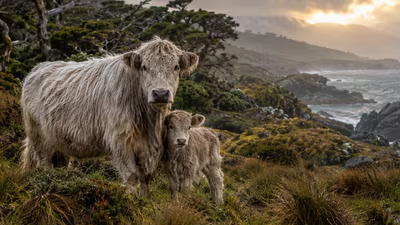
According to a 2022 paper by Michael Trotter and Michael Willis in the New Zealand Journal of Ecology on the history of livestock on the Auckland Islands, that is what happened. The paper also shows how in 1993 a handful of determined people saved the last survivors. But one of the rarest breeds of cattle in the world began as a small herd of farm animals that were just left behind.
When most people hear “rare animal,” they think of tigers or pandas.
In the second half of the 20th century, New Zealand began removing introduced animals from the islands to restore the original environment. Trotter and Willis point out that this raised a tough question: should one element of biodiversity be sacrificed to save another? The early attempts to get a calf from Lady failed. So scientists at the Ruakura Research Center in Hamilton attempted to clone her. DNA tests proved the calves were genetically identical to Lady. The survivor, named Elsie, was one of the first cloned cattle in the world.
In early 1991, a team visited Enderby Island and culled 47 animals: 25 cows and 22 bulls. Semen from 16 bulls was frozen for future use. In a 1998 report in Reproduction, Fertility and Development , David Wells and colleagues report that they cloned her from mural granulosa cells. In the first experiment, 22 embryos were transferred, two calves were born alive, and one survived.
Egg cells collected from 11 cows failed to mature, so that part of the rescue plan did not work.
