
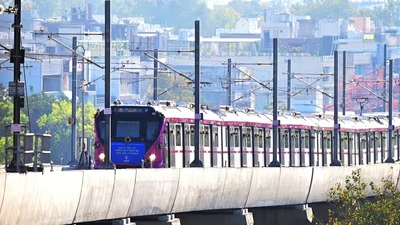
The Delhi Metro Rail Corporation ( DMRC ) will run 20 additional train trips on weekdays from Thursday, October 22, amid Stage I of the Graded Response Action Plan (Grap) in the city to tackle deteriorating air quality.
The additional metro services and intensified construction-site inspections announced by DMRC come as authorities step up measures to prevent air quality from deteriorating further. The corporation will also step up dust-control measures at construction sites and on roads under its jurisdiction across the national capital. Open waste burning is prohibited, and coal and firewood ovens or grills are barred in eateries and commercial kitchens.
HT reported on Thursday that Delhi’s AQI had reached 245 at 4pm on Wednesday, marking the highest reading of the season and the worst since July 13. Under Grap Stage I, dust-control measures are mandatory at construction and demolition sites, while projects covering more than 500 square metres require an approved dust-management plan. Diesel generators are restricted to essential and emergency services, while authorities are required to act against visibly polluting vehicles, industries and thermal power plants within 300 km of Delhi.
The DMRC said it is also intensifying anti-pollution drives at its construction sites and surrounding areas as Delhi-NCR. In a post on X on Wednesday evening, DMRC’s official handle, @OfficialDMRC, said the additional services would encourage more commuters to use public transport instead of private vehicles. The announcement comes after the Commission for Air Quality Management (CAQM) invoked Grap Stage I across Delhi-NCR on Wednesday, following a sharp deterioration in air quality that pushed Delhi’s Air Quality Index ( AQI ) into the ‘poor’ category.
What anti-pollution measures will DMRC take?
Approximately 31 kilometres of city roads are currently under DMRC’s temporary jurisdiction to facilitate metro construction work. More than 250 anti-smog guns and mist guns have also been installed at construction sites, metro stations and office buildings to reduce dust levels. Delhi’s Air Quality Index (AQI) rose from 179, in the ‘moderate’ category, on October 20 to 244 at 2pm on October 21, entering the ‘poor’ category, according to the CAQM order.
Metro engineers will inspect construction sites and nearby roads to ensure that construction materials are properly covered and wheel-washing facilities for vehicles leaving the sites are functioning. These measures are intended to limit dust from construction activity and prevent it from spreading to surrounding areas. DMRC’s Environment Department conducts daily inspections to ensure compliance with environmental norms. GRAP is a set of emergency measures implemented in phases to tackle worsening air pollution across Delhi-NCR. Stage I applies when air quality enters the ‘poor’ category and requires authorities to strengthen pollution-control measures. The commission cited forecasts from the India Meteorological Department and the Indian Institute of Tropical Meteorology, which indicated that air quality was likely to remain poor over the coming days.
The intensified drives will focus on reducing dust at construction sites, removing accumulated dust from surrounding roads and clearing garbage from footpaths and road medians, according to DMRC. The corporation said the additional drives would supplement the pollution-control measures already in place. Most of these roads have already been repaired by the corporation to prevent them from contributing further to pollution, DMRC said.
The CAQM invoked the first stage of the Grap across Delhi-NCR on Wednesday after Delhi’s air quality deteriorated sharply following Dussehra celebrations.
