
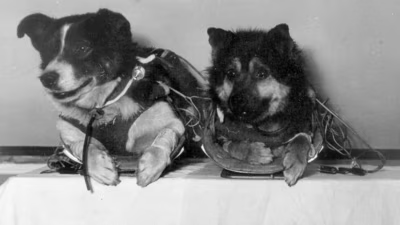
Veterok and Ugolyok were launched aboard the Soviet Cosmos 110 spacecraft on February 22, 1966, and returned safely to Earth on March 16, after 22 days in orbit. The mission examined the effects of prolonged spaceflight, including exposure to radiation from the Van Allen belts. Scientists tracked the dogs’ vital functions, recorded their radiation exposure, and assessed their physical condition after landing.
The records describe the flight and the medical observations made during and after the mission. The findings also showed why researchers needed to examine the animals after their return, rather than treating survival alone as an indication of the mission’s success. On each orbit, the spacecraft passed through the Van Allen radiation belts, regions above Earth where charged particles are trapped by the planet’s magnetic field. Radiation exposure was another focus of the experiment. This equipment allowed researchers to collect data on the radiation environment during the flight. The spacecraft also carried equipment to monitor the dogs’ health. Electronic sensors continuously recorded blood pressure, pulse, and respiration, allowing researchers to observe physiological changes during the mission. One dog underwent tests to assess cardiovascular responses, while the other served as a control for comparison. Both were secured in harnesses, and a pneumatic device delivered food paste directly into their stomachs. After the spacecraft returned to Earth, researchers examined Veterok and Ugolyok to assess the effects of their extended time in orbit. The examinations also identified changes in the dogs’ skeletal systems, including calcium loss. Their recovery illustrated the difficulties of readjusting to Earth’s gravity after an extended period in space. The observations also showed that some effects of spaceflight persisted after the spacecraft had landed. Together, the radiation measurements, continuous physiological monitoring, and post-flight medical examinations gave researchers a more detailed picture of the effects of prolonged spaceflight. The different stages of observation helped scientists identify changes that could not have been assessed through the successful recovery of the animals alone.
The objectives and findings of the mission are documented in NASA’s historical publication Astronautics and Aeronautics, 1966 . The Soviet Union launched Cosmos 110 on February 22, 1966, with Veterok and Ugolyok aboard. The spacecraft returned on March 16, completing 330 orbits around Earth during its 22-day mission. NASA’s historical account records that Cosmos 110 carried 300 thermoluminescent dosimeters to measure radiation doses in relation to spacecraft shielding, along with 10 sets of nuclear emulsions to help determine the composition of the radiation encountered. The findings recorded in NASA’s Astronautics and Aeronautics, 1966 , including its May 16 entry, noted elevated pulse rates and dehydration. NASA’s historical account, A New Beginning , reports that the dogs’ motor systems took eight to 10 days to return to normal after the mission.
