
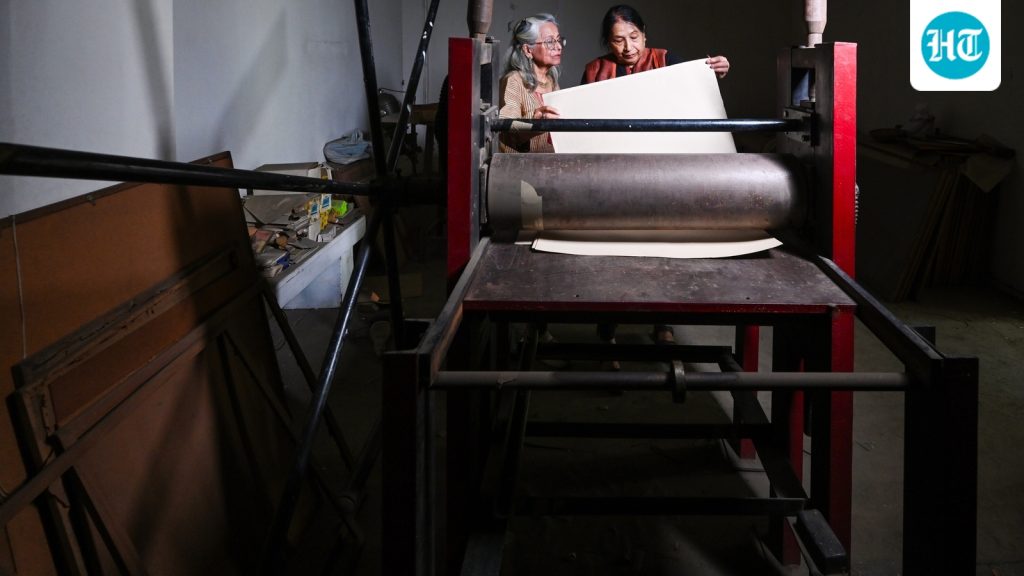
The machine once belonged to 82-year-old Anupam Sud. The premises of the Delhi Silpi Chakra have not been opened in years and a fine patina of dust covers the floors. Paintings still hang on its walls, and many lie stacked up against them. Darkness envelops a side room until the balcony door is forced open and sunlight streams in, illuminating a printing press in the centre of the room. Built locally and designed by her professor and mentor Jagmohan Chopra, it is one of the few presses that helped shape Delhi’s nearly forgotten printmaking legacy.
“Through this retrospective, Anupam Sud’s work needs to be looked at as a microcosm of the evolution of Indian art since Independence. B. C. Sanyal, the first chairperson of Delhi Silpi Chakra, and K. S. Kulkarni, one of its co-founders, were visiting faculty members; Jaya Appasamy, artist, art critic, and co-founder of Delhi Silpi Chakra, also taught at the college. But it was Chopra, her professor, who played the most prominent role. Printmaking, then and now, is a resource-intensive practice — requiring acid, copper and zinc plates, felt, rollers, and printing presses — as well as a physically demanding one. “I remember asking Jagmohan Chopra why was printmaking taught if there was no infrastructure outside the college to pursue it? Jain was his student in the early 1970s. Sud too would visit Chopra’s home and spend the entire day on the machine that he placed in his drawing room, she recalled. During her year at Slade, where she studied printmaking, Sud sent elaborate sketches of the machines and other equipment to Chopra. The idea was to try and get them made — something that Chopra often succeeded in doing. “In England, I saw the aquatint box for the first time and I sent detailed drawings to him. When I returned, we got a carpenter to make the box and it turned out beautifully. An aquatint box is used in intaglio printing and lets fine particles of rosin powder fall onto the zinc or copper plate, which in turn helps create the print’s texture. “When I joined the college, most of the infrastructure was lying in disarray and in disuse. Though printmaking in India began in the 19th century, it truly came into its own in the mid-20th century, as artists across mediums experimented with different printmaking techniques. Back home in India, Santiniketan and later, MS Baroda University proved to be printmaking hubs for artists: everyone from Nandalal Bose to Somnath Hore, and later, Shanti Dave, Gulammohammed Sheikh and Jyoti Bhatt, were pioneers. In Mumbai too, in the 1950s, MF Husain, Ram Kumar, Bhupendra Karia and others ventured into printmaking through a short-lived collective. Sud belonged to this lineage of artists who not only elevated printmaking into an epistemic practice capable of holding political and philosophical meaning but also one that engaged with international trends while rooted in the local and personal.
Born in 1944, Sud joined what was then under the umbrella of the Delhi Polytechnic in 1962. Sud’s journey as a printmaker went hand in hand with her teaching career; she joined the College of Art in 1975 as a lecturer in the printmaking department. Krishna Reddy, who is one of the country’s most well-known printmakers, achieved great finesse in Paris, working with William Stanley Hayter’s Atelier 17. In 1965, the Delhi Silpi Chakra held the country’s first all-India Graphic Show; 33 artists, including Chopra, Karia, Reddy, and Hore, showed their works.
Her works of each decade, even though they are reflective of her personal journey as an artist, also in some way reflect what was catching the attention of the common Indian at that time,” said Singh. Sud said. “I remember changing three buses, and walking a kilometre to reach Jagmohan Chopra’s house to work on the press,” Santosh Jain, the chairperson of Delhi Silpi Chakra, said. Up until then we would use cloth potli to dust powder on a plate, but the aquatint box mechanised the process,” Sud said. “The ecosystem of the small printmaking community in Delhi in the late 1960s—under the insightful leadership of mentor Jagmohan Chopra—played a vital role in nurturing young artists, helping them acquire exposure through workshops and facilitating interactions with the network of galleries and art patrons from all over India,” Khare-Ghose writes in ‘Retrospective: Anupam Sud’. I got them repaired and we were given three studios, one each for lithography, etching, and linocut and woodcut,” she said.
Sud is herself a formative part of the Capital’s cultural history. The exhaustive display will include works from her growing-up years in Simla, her sketches, paintings, watercolours and prints from her college days, the prints made during her time in London, to increasingly mature works made in the subsequent decades. This is the first time that a retrospective will present Sud’s prints in the context of her other artistic practices.
After graduating from Delhi Polytechnic (later the College of Art), she joined Group 8, a collective steeped in printmaking experiments. After returning from the Slade School of Art in London, she joined the Delhi Silpi Chakra, an arts society founded in 1949, and continued her printmaking practice. Starting October 23, a grand retrospective at the National Gallery of Modern Art (NGMA) will showcase the breadth of Sud’s oeuvre, and with it, offer a slice of Delhi’s history. The month-long exhibition will be presented by the Dhoomimal Gallery, which turns 90 this year, and has been conceptualised by Amandeep Singh, a long-time collector of Sud’s works.
Chopra responded by doing two things. One, he formed a collective called Group 8 in 1968. The idea was to help recent graduates like Sud and other artists like Priya Mookerjee, Sunita Kavinday, Laxmi Dutta Gupta, Umesh Verma, Santosh Jain, Vijay Sharma, Yogshakti Chopra and Indira Gupta, among others — all initial members of Group 8 — to continue with printmaking.
And two, he set up a makeshift printmaking studio at his home: “He made several trips to Turkman Gate to get the machine made,” Sud said.
Dhumal, Rameshwar Broota, Vasundhara Tewari Broota and Ranbir Kaleka, among others, will also be released at the exhibition curated by Archana Khare-Ghose. A book on Sud’s life, with essays from other artists, contemporaries and printmakers, like P. D.
