
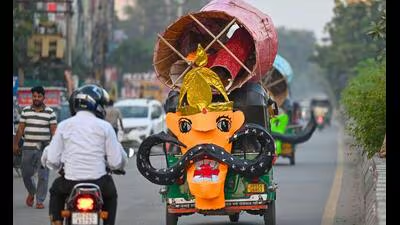
Inside the makeshift tents lining a road in Gurugram’s Sector 15, brightly coloured faces lie scattered on the ground, their painted eyes staring upwards. Nearby, bamboo frames are taking shape as families work on arms and legs, transforming paper, cardboard and bamboo into towering effigies of Ravana.
In a few days, their creations will go up in flames, marking the victory of good over evil on Dussehra. For the families who have spent weeks making them, however, the festival represents something more immediate: a month’s livelihood, a craft passed down through generations and, for some, an opportunity to earn a little extra. For Vinod Kumar, making Ravana effigies is a family tradition stretching back at least four generations, to his great-grandfather. The rest of the year, he sells bamboo products. Together, they fashion effigies of different sizes, keeping them ready for customers to pick up and transport to neighbourhood grounds and residential complexes. It is an income that depends not only on the skill of their hands but also on the collective effort of every family member. But not everyone working beneath these tents has inherited the craft. Govind, who comes from Agra, ordinarily earns his livelihood buying and selling shoes. This year, he has joined his relatives in making and guarding Ravana effigies, learning the intricacies of an entirely different trade. Working alongside him is Sonu, a cab driver who has just completed his first Ravana effigy. For him, the seasonal work offers both additional employment and a welcome change from his usual routine. For Khushboo, the work is a more solitary undertaking. Her four children are still too young to help with the demanding parts of the craft, although they do their bit by passing her paintbrushes as she works. The materials come from different places: patterned paper and shimmering foil from Delhi, while bamboo, cardboard and newspapers are sourced locally. Each family has one person entrusted with painting the eyes and teeth as these are the details that give Ravana his unmistakable expression. Others generally leave these finishing touches to the designated artist, reluctant to risk spoiling the painstakingly assembled paper faces. The work is seasonal, but for some families, one festival simply leads to another. Once the Dussehra effigies have been sold, they will turn to Diwali decorations, moving from one short-lived festive market to the next. There is also the constant worry of protecting what they have made. On Dussehra, crowds will gather to watch Ravana burn, his brightly painted face disappearing into the flames.
But a month before Dussehra, he sets up shop along the roadside in Sector 15, accompanied by his wife and three grown-up children — two daughters and a son. The family produces around 35 to 40 effigies during the festive season, earning close to ₹ 60,000 over the month. She makes around 10 to 15 effigies during the season, earning close to ₹ 25,000. For the families in Sector 15, the real achievement lies in everything that came before — the bamboo tied together, the paper carefully pasted, the eyes painted by practiced hands, and the weeks of work that made those few minutes of spectacle possible.
Because a fire could destroy weeks of work and the earnings that depend on it, the completed effigies must be guarded carefully until they are collected,.
“It takes a family to make these,” Vinod said. “We have to carefully think about the design, buy different colour papers for the crown, the face, and the moustache,” he said. “I got bored with cab driving, wanted to do something different during the festive season,” he said. Across the tents, the work is divided according to skill and experience. “We have to carefully guard all the Ravanas, otherwise somebody can set fire to them ruining our entire month’s hard work,” Vinod said.
