
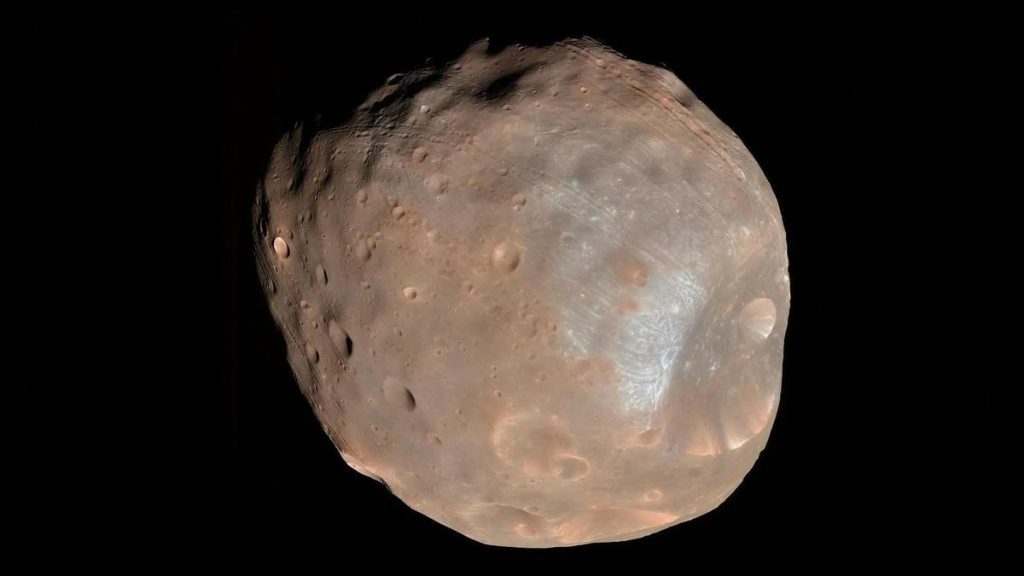
Japanese scientists successfully launched a spacecraft Tuesday (October 20, 2026) that aims to be the first to retrieve samples from one of Mars’s moons, potentially helping unlock the origins of the Solar System and life on Earth.
The flagship H3 rocket carrying the unmanned Martian Moons eXploration (MMX) probe blasted off into a pitch black sky from the Tanegashima Space Center at 4:41 a.m. (1941 GMT Monday), according to a live stream broadcast by the Japan Aerospace Exploration Agency.
Once MMX arrives on Phobos, it will collect at least 10 grams (0.35 ounces) of material from the surface during its planned three years in the Red Planet’s vicinity. The spacecraft is due to arrive near Mars around August next year, where it will orbit one of its moons, Phobos. The mission — which aims to be the first round trip to the Martian region — is a collaboration with U.S. and European space agencies, as well as numerous universities and tech companies. Scientists hope it will help lay the groundwork for eventual human exploration.
One theory for the origin of the moons — the “giant impact” hypothesis — is that they formed after a celestial body collided with Mars.
