
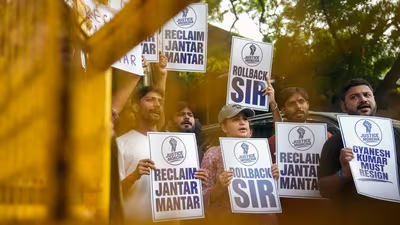
Vinay Sreenivasa spent three years fighting the restriction of protests in Bengaluru to a single, low-visibility ground: Freedom Park, the site of a former central jail in Gandhi Nagar. So, when flash protests erupted across Delhi last week — small groups marching through Connaught Place, Sansad Marg and Dilli Haat INA, with some even attempting to reclaim the barricaded stretch of Jantar Mantar after it was denotified as a designated site — the lawyer-activist who runs the Campaign for the Right to Protest recognised the pattern.
The Master Plan, from the first plan of 1962 onwards, had reserved 20% of land for greenery and open space, he pointed out. Because the moment a ground was marked for that purpose, it became a political controversy, planners, he added, generally avoided designating specific protest sites. As a result, the right to protest depends largely on police decisions and government orders. Because of the changed circumstances, later, that arrangement changed.
It is not just in Bengaluru and Delhi that the geography of protest has been shifting. In several major cities across the country, demonstrations are increasingly being channelled into designated spaces away from centres of power and public attention. Urbanists and activists say this is changing not just where citizens can make their voices heard, but also how public spaces are used, who gets access to them, and what role they play in a city’s political life. “What the cities are trying to do is exercise spatial control and lock up dissent. “Protest should be allowed at the relevant site: outside the municipal office that has ordered an eviction, outside the transport corporation that has hiked bus fares, anywhere in the city where the grievance arises. But, that is no longer possible,” he added. In Mumbai, large protests that could once be organised at Girgaon Chowpatty, Hutatma Chowk and August Kranti Maidan are now concentrated in a heavily policed corner of Azad Maidan. In Chennai, demonstrations that were once held along the open promenade of Marina Beach have been restricted to designated inland stretches such as Valluvar Kottam and Swami Sivananda Salai. In Kolkata, processions that once moved freely through the Maidan and Esplanade are now often directed into small, cordoned lanes such as Rani Rashmoni Avenue or the gated enclosure of Metro Channel (Y-Channel). “The distance between a protest site and the seat of power can determine how visible a grievance becomes, how easily people can gather and whether those in power can see, hear or ignore them. AK Jain, former commissioner (planning) at the Delhi Development Authority (DDA), made an institutional distinction. “These open spaces are marked in the plan. But the decision about where protests will actually be allowed is not a planning decision. “I think it is important to turn this on its head. A protest is not an interruption of life. It is life. It is precisely what fights for all that is precious in life: truth, dignity, fairness, respect, recognition. It does not have to be managed — it has to be welcomed,” he added. “Peaceful gatherings — whether protests, political rallies, festivals or religious ceremonies — all require designated places. The purpose of the assembly must be served, but so must the convenience of motorists, pedestrians, residents, shopkeepers and vendors. Democracy works through this balance. Where permission is granted, he added, depends on factors including the day, competing events, crowd size, the risk of a peaceful gathering turning unlawful, the possibility of a stampede, and routes for ambulances and evacuation. “The location of protest is an administrative call shaped by the realities of the time. Boat Club once served as Delhi’s designated site. Spaces of protest, Bhan argued, are not planned. They are claimed. The more they are restricted to a single site, the stronger the eventual claim on multiple sites is likely to become. religious processions, pandals and festivals have grown more assertive While political processions have been confined. Loudspeakers, drumming and the occupation of roads continue late into the night. “Political protest is not the principal source of noise, litter or traffic disruption in the contemporary city. It is the steady and very public expansion of religion into every aspect of Indian public life. As Nair has argued, the removal of protests from central locations has also been driven by middle-class aesthetics and the desire for an ordered city. The removal of demonstrations from Cubbon Park, she noted, was partly the result of pressure from walkers and those seeking to preserve green space — a legitimate demand. “But, it was also a symptom of a deeper discomfort. Part of the reason is the inability of the political class to confront the noisy actions of Indian democracy. Sreenivasa returned to the point that had driven his campaign for three years. It is a form of dialogue when I am not being heard.”
Public spaces should be left to the public,” Sreenivasa said. “Where citizens are allowed to protest in a city reflects how a city accommodates dissent,” said Aditya Sharma, an author who participated in the recent Jantar Mantar protests. It is a law-and-order decision taken by the police,” he said. “A very common word that people use for protest is that it is an ‘interruption’ or ‘disruption’ that has to be managed,” Bhan said. Muktesh Chander, former special commissioner of police, Delhi, and former Delhi traffic police chief, said the choice of protest sites have to balance the purpose of an assembly with the convenience and safety of other city users. It is the police’s job to manage law and order and traffic: issue advisories, create alternate routes, and ensure residents are not unduly affected,” he said. What worked at one time may not work in another,” Chander said. “Power always creates its own resistance,” he said. Nair said that in Bengaluru there has been a different and parallel expansion of public life. “Under the cover of religion, every possible municipal and traffic law is violated with impunity,” she said. The same municipal and police authorities that restrict political assemblies routinely facilitate religious ones,” she said. They themselves may have taken root in such demonstrations, but once in power it is not quite the palatable mode of doing politics,” she said. “What cities need to understand,” he said, “is that protest is not anarchy.
Under a 2009 order, protests involving more than 250 people required a licence, but demonstrations were not confined to a single venue. In 2021, after protests disrupted morning traffic, a high court judge wrote to the chief justice, triggering a suo motu public interest litigation. the police commissioner issued a new order, which came into effect in early 2022 and restricted protests to Freedom Park While the case was pending. In March 2022, the high court issued an interim order confining protests to Freedom Park. In October 2023, members of the Campaign for the Right to Protest challenged the rule by gathering at the Gandhi statue at Maurya Circle, outside Freedom Park. Restrictions after the 1988 farmers’ rally moved them to Jantar Mantar. The sites designated in its place are Ramlila Ground, CBD Ground in Shahdara (roughly 14 kilometres away) and Burari Ground in north Delhi (over 20 kilometres from Parliament House).
In Bengaluru, the restrictions came in stages. When it disposed of the petition in August, it directed the authorities to enforce the police order. The restriction originated in the police order, not a final judicial ban on protests elsewhere. “But, that was not the order of the court. They were detained, and a case was registered against them. Janaki Nair, a former professor of history at Jawaharlal Nehru University (JNU) and author of The Promise of the Metropolis: Bangalore’s Twentieth Century, which examines the spatial, social, and cultural transformation of Bengaluru, viewed the confinement of protests to Freedom Park from a broader perspective. The same logic of concentration and containment is visible across urban India. “Part of what a protest does is to make the familiar strange — to make us stop, pay attention, and realise something is not what it is meant to be. In Delhi, as in other cities, that distance has grown over the decades. Large demonstrations once filled the Boat Club lawns near India Gate, close to Parliament and the ministries. “There are cracks in the foundation of our society. Protests seek to heal them, to draw attention to them — they do not cause them. Yet a society that fears protests is trying desperately not to look at the cracks in its own self. Cities in India, as elsewhere, have almost never formally provided for spaces of protest in their master plans. “It can be used for equity and a more open sense of publicness, but also to impose control and order. It is the language of the state, and so usually the latter win out. Indian cities still carry strong legacies of colonial planning — we, ironically, police our own people the way colonisers once sought to contain natives,” he added.
But Sreenivasa said the police had since treated the interim order as a blanket prohibition on protests at other locations. “Now, any time anybody tries to organise a protest outside Freedom Park, the police keep quoting the interim order of the high court, and say you can protest only in Freedom Park,” he said. “As a confined space, somewhat isolated from the street and from government, it is clearly intended to ‘control’ and make irrelevant the spaces for dissent,” she said. “It is a defence, an attempt to turn away, an attempt to evade accountability, to not listen,” said Gautam Bhan, an urban researcher and writer. That act of seeing, hearing, walking, and confronting is where protests make meaning: to make a citizen ask, ‘What are they fighting for?’ and to force a state to ask, ‘What are they asking of me?’” Distance, Bhan argued, does more than simply relocate bodies: “It breaks the interaction. It breaks the DNA of what a protest is,” he said. “Cities that seek to restrict protests are seeking to hide from themselves — from their inequalities, from the frictions and fissures that can be masked temporarily before they burst through,” Bhan said. “Planning has a history of spatial control,” Bhan noted.
