
As much as 48,000 years ago, a cave painting in Indonesia shows, hunters wore animal skins and masks as camouflage. Native Americans hid in buffalo hides and feathers as they stalked their prey. Irish hunters covered themselves in branches.
Thousands of years later, the trick would be used in war. Julius Caesar, invading Britain in the 1st century BCE, reportedly used Venetian blue to coat ships, so they could scout without being too noticeable. Across millennia, the materials and methods have changed. Take a look. HOW IT STARTED In the 1890s, amid the Spanish-American War, painter Abbott Thayer tried to persuade the US government to use graded colours and tones for concealment, inspired by his study of how certain animals did this in the wild. Roping in artists, set designers and sculptors, they created hooded smocks and painted rifles in drab green and brown, as well as fake trees that concealed sentry posts. This way, he reasoned, the enemy might find it harder to secure a direct hit. Dazzle camouflage became a pop-culture sensation too, turning up on dresses, shirts and swimwear. IS IT A BIRD? IS IT A PLANE? By now, the armies of the US, UK, Germany, Italy and Russia had each created a range of prints for their uniforms, designed to suit various landscapes: snow, desert, forest, tropical jungle. The most widely used of these are the tiger stripes, French lizard, and the frog skin, that last one perhaps the most recognisable of all. Unlike traditional camouflage, which use macropatterns with sharp outlines, this used macropatterns and pixelated micropatterns that blur together at a distance, causing visual dissonance and confusion. The early Aughts marked the spread of such digital designs. Chief among these was the universal camouflage pattern (UCP), a pixelated bluish-grey print adopted by the US Army, but abandoned after it only served to highlight soldiers, against the dark mud and arid deserts of Afghanistan. Modern combat uniforms are often also treated with thermal coatings and passive emission barriers that absorb or mask body heat, blinding heat-sensing surveillance. A range of such artefacts are now on display at the International Spy Museum in Washington DC, where an exhibition titled Camouflage: Designed to Deceive opened in March and runs all year. THE COUNTER-CULTURE By the 1960s, these patterns were entering the mainstream with an unlikely message: peace. The designs came to represent a disciplined, militant counter-fight too, with groups such as the Black Panther Party wearing camo jackets. This would filter down through generations, as artists inspired by that party, such as Tupac Shakur and Nas, chose camouflage as they waged their battles against inequality and racism.
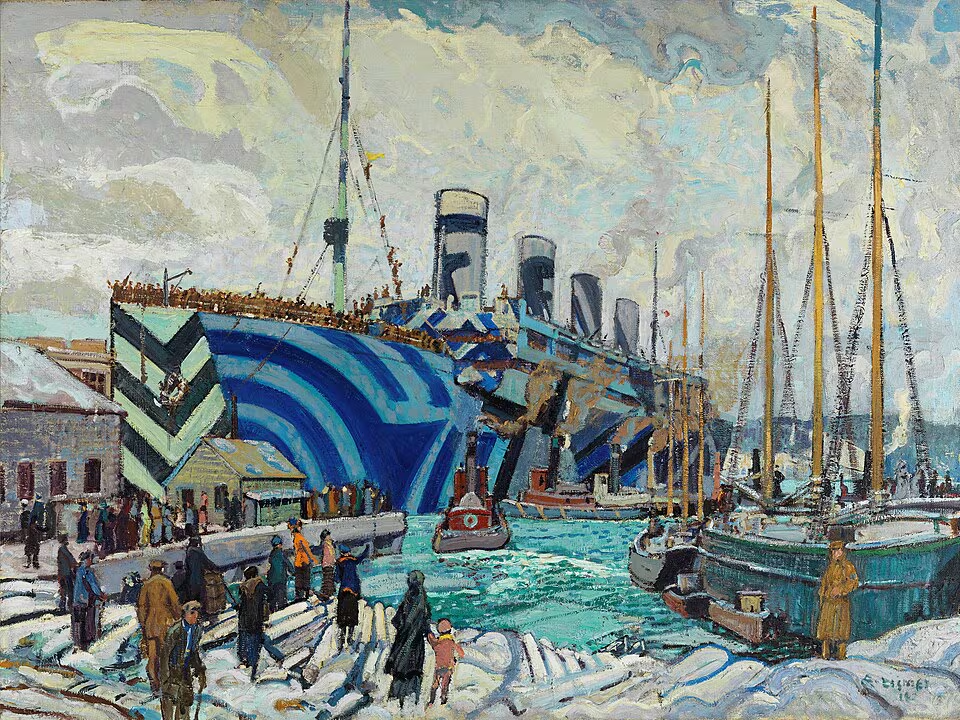
The government remained unconvinced, but his work would lead other artists to create the early prints used during World War 1. WARSHIPS THAT DAZZLED AT SEA By 1917, British lieutenant Norman Wilkinson had pioneered the idea of painting warships in bold, zigzag black-and-white lines, to distort perception of their size, speed and direction. By World War 2, aircraft were being painted in darker earthy tones above and light tones below, to camouflage them against the ground and sky. THE ALL-ENVIRONMENT PATTERN In 1996, Canada launched the Canadian Disruptive Pattern or CADPAT, the world’s first digital variant. By 2010, US troops had switched to MultiCam, which uses high-resolution, organic, flowing shapes to match textures of dirt, rocks and leaves, in shades of green, brown and tan. Amid the Vietnam War (1955-75), veterans and protestors turned camouflage jackets into political statements, scrawling anti-war messages on them, adding anti-war badges and flowers. They would migrate from there into fashion, reimagined by Jean Paul Gaultier; worn by Madonna at the 2017 Met Gala (in an outfit designed by Jeremy Scott).
These are now evolving beyond physical patterns, to embrace advanced materials and smart textiles so that they can account for drones, military VR headsets and smart surveillance systems too. As a result, he is considered the father of camouflage.
It was the French army that first established a dedicated, secret unit clad in such gear, in 1915. (The word itself comes from the French “camoufler”, for “disguise”). “These designs are so ideologically charged that, even when worn as fashion statements, they could be read as an anti-war gesture aligned with anti-imperialist left-wing politics,” says Louisa Rogers, an assistant professor of fashion communications at Northumbria University, UK, whose research focuses on representations of surveillance and militarism in fashion. This is the most widely used type today, worn by police officers, SWAT teams and ICE agents too. THE RIGHT TO GO UNSEEN Today, designers and apparel brands are experimenting with camouflage for everyday use, creating masks and jackets designed to trick AI-powered cameras and surveillance systems.
The future of such camouflage, says Rogers, will likely look a lot like the dazzle stripes of the World War 1 era.
“As systems evolve, our responses to them will too,” she adds, “and this will result in a range of evasive prints, patterns and techniques that we may not yet be able to imagine.”
