
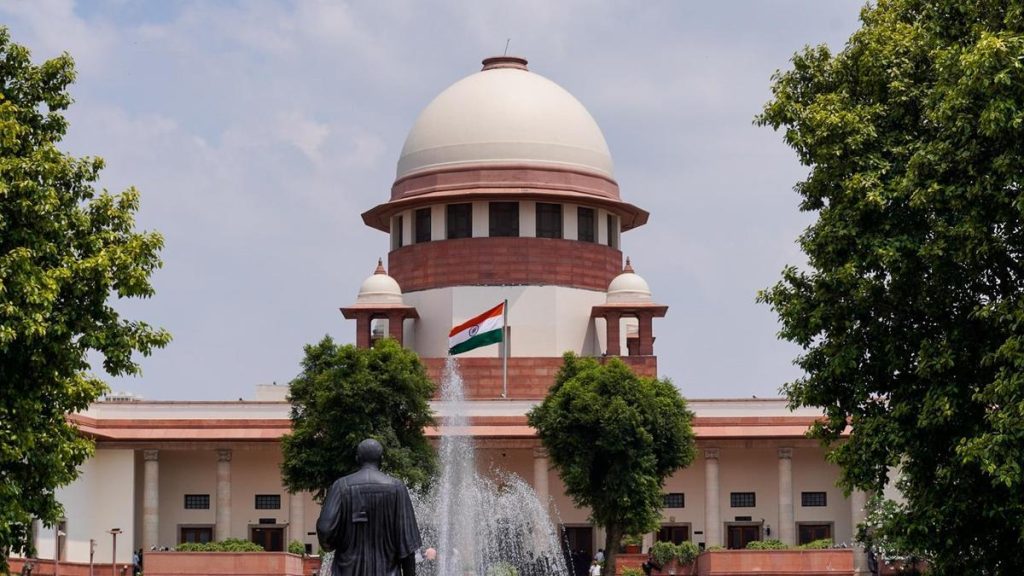
The story so far: The Supreme Court, in an October 15 judgment, declared that a Hindu who had converted to a “non-Hindu order” cannot claim the benefits of reservation.
A Bench of Justices Prashant Kumar Mishra and Shree Chandrashekhar held that a person who converts from a Hindu social order to a non-Hindu social order cannot claim affirmative action under Article 16(4) of the Constitution merely on the basis of the social backwardness associated with his pre-conversion status. The controversy in the case of Secretary to Government versus Sameer Ahamed N. began with a man, born to Hindu parents in 1993 at Thoothukudi district in Tamil Nadu, voluntarily converting to Islam in September 2015. He procured a testimonial of his conversion from the Sunnath Jamath and applied to the local taluk office in November 2020 for a Backward Class (Muslim) community certificate to claim a share of the state’s quota benefits. 31 on March 9, 2024, permitting individuals belonging to Backward Classes, Most Backward Classes, or Denotified Communities prior to conversion to obtain Backward Class Muslim certificates if they integrated into any of the seven recognised Muslim sub-groups. During the hearing, Justice Mishra had referred to a 1951 judgment of the Madras High Court in G. The 1951 verdict had upheld the constitutional validity of Paragraph 3 of the Constitution (Scheduled Castes) Order, 1950. Paragraph 3 stipulated that no person who professed a religion different from Hinduism (later amended to include Sikhism and Buddhism) should be deemed the benefits of a Scheduled Caste member. To this, the State had responded that the 1951 judgment did not disable the State from classifying a convert, who was previously socially and educationally backward, as a Backward Class Muslim. The apex court said deep-rooted flaw in the March 2024 government order was that it treated the historical disadvantage of a person in one religion as sufficient proof of membership in a particular Backward class in another religion. A Scheduled Caste status was specifically governed by Article 341 which mandated that only the President could notify a group as Scheduled Caste. A person, who has converted to a religion outside those specified in Paragraph 3, cannot continue to claim Scheduled Caste status merely by reference to his caste of origin. The October 15 judgment has closed off administrative shortcuts created by States attempting to ease transfers of reservation.
After embracing Islam, Paramasivara — who changed his name to Sameer Ahamed — confirmed his choice by marrying within the community and professed the faith of Labbai Muslims. Thus began a long legal battle, which started with the Tahsildar’s office and travelled all the way up to the Supreme Court, transforming the issue to far beyond the issuance of a community certificate. Comment | Denying Backward Classes benefits to converts to Islam is unconstitutional The local authorities rejected his application, ruling that while he had converted his religion, he had not transformed his underlying caste. Ahamed received unexpected legislative support when the Tamil Nadu Backward Class Commission recommended a mechanism to assist proselytes. Consequently, the State Government issued G.O.(Ms.) No. However, the Madras High Court struck down this government order. The High Court reasoned that a person who converts to Islam cannot claim the status of Backward Class (Muslim). It observed that a Hindu, on conversion to Islam, did not carry forward the benefits of the Hindu caste or sub-caste. A convert’s status in Islam was not decided by the caste he was part of prior to the conversion. The High Court reasoned that Christian missionaries as well as Islamic preachers maintained that their religions offered social equality unlike Hinduism, which had a caste hierarchy. It observed it was disingenuous to claim hierarchy in Islam also. Islam sought to establish an egalitarian society. Tamil Nadu government submitted that the intent of its order was to ensure that persons belonging to socially and educationally backward communities were not deprived of reservation benefits solely for converting to Islam. All it wanted was to lay out a level playing field by preserving affirmative action despite change of religion. Michael versus S. Venkateswaran, regarding a Scheduled Caste member who converted to Christianity and wanted to contest in a reserved seat. The State further referred to the court’s judgment in Indira Sawhney case that observed that among non-Hindus, there were several occupational groups, sects and denominations, which for historical reasons were socially backward. The apex court took the opportunity to widen the ambit to examine the legal consequences of a person’s conversion from Hinduism to Islam and, in particular, whether a person belonging to a Backward Class, Most Backward Class, De-notified Community or Scheduled Caste prior to such conversion could claim the status and consequential benefits of a Backward Class Muslim. The judgment authored by Justice Mishra dismissed the State’s appeal while upholding the Madras High Court’s decision. The court held that a private religious body, like a Jamath, cannot, by issuing a testimonial, conclusively determine a statutory Backward Class status. The government order did not explain why a Hindu belonging to one Backward Class community or a Most Backward Class community or a De-notified Community or a Scheduled Caste could, upon conversion to Islam, become a member of one or another of seven pre-existing Backward Muslim communities. Explained | The Scheduled Caste classification and the religion bar: What has the Supreme Court ruled? The court made it clear that community certificates cannot be deployed as an instrument to create a new social status. The ruling confirms that affirmative action remedies are tailored to group-based disadvantages recognised under specific legal frameworks.
The State argued that its government order applied to the “wholly distinct category of backward class notification, which contains no religion-based exclusion”. Besides, the court said that a Scheduled Caste status of a person could neither be altered or recreated by a mere government order.
Challenging this rejection before the Madras High Court, Mr. The High Court decision led the State of Tamil Nadu to appeal before the Supreme Court in challenge.
