
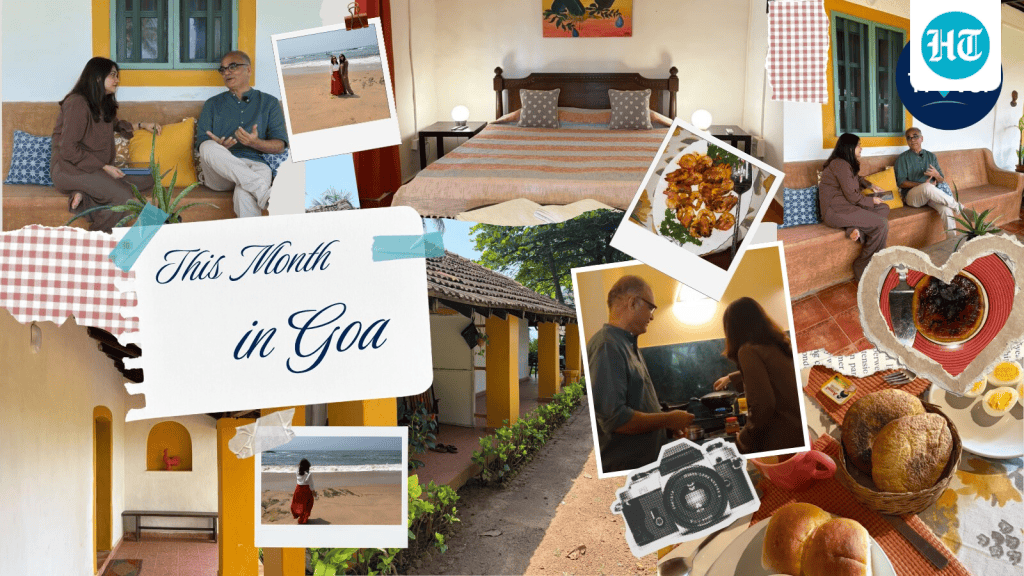
I reached Anjuna at 3 am after a terribly delayed flight and, by the time I finally got into bed at Sobit, one of Cezar Pinto’s cottages in South Anjuna, I had already accepted that the next morning was going to be rough. Strangely, at 7 am, I felt rested. I had barely four hours before I needed to wake up again. I think it was the ocean. You can hear the Arabian Sea from the cottage, not as an overpowering roar but as a constant rhythm somewhere behind everything else. Through the night, those waves became almost like white noise for a very disturbed, very tired mind. Four hours of sleep had absolutely no business feeling that good, but somehow they did.
Cezar spent his childhood summers in Anjuna, but his memories are not quite the dreamy childhood by the sea story you might expect. “There was nothing happening. For anyone who has recently sat in Anjuna traffic or tried getting a table at a popular restaurant on a Saturday evening, the thought of children complaining that nothing happened here feels almost absurd. What I loved was listening to Cezar laugh about being the little boy who did not want to spend his summer holidays here. The family weekend home that once represented those boring holidays has become something he loves sharing with other people. There is something wonderfully circular about that. Our conversation eventually moved from the sitting area into the kitchen, and Cezar and I started cooking together while we continued talking. Soon there was ros omelette, peri peri prawns with feni and poee on the table. The prawns were fiery with chilli and garlic, while the feni gave the preparation a distinctly Goan character. The ros omelette came with the rich gravy that turns something as simple as an omelette into one of Goa’s most satisfying street food meals. That brunch was one of my favourite parts of the stay. We were talking about Goa while cooking Goan food in a Goan home, with the sea still audible outside. There was no need to manufacture a sense of place. It was already there. For someone so relaxed in conversation, Cezar became very clear when I asked what he wished travellers understood about staying in someone else’s property. Respect the home as you would your own. Respect the surroundings and the neighbours too. It sounds basic, but in a destination receiving visitors throughout the year, the small things matter. Goa’s traditional tourism calendar is changing too. Repairs and maintenance that are difficult during continuous bookings are prioritised whenever a free week appears. A heritage home may look wonderfully effortless when you arrive, but keeping it that way is anything but.
Because it was elaborate, but because the food belonged to the conversation we were having, not. Because traditional properties constantly need work, for hosts, those relatively calmer weeks are valuable.
“We used to hate coming to Goa because it was so boring,” he laughed. It felt completely natural, which perhaps says more about his style of hospitality than anything else I could write. The monsoon months once created a much clearer quiet season between June and September, but Cezar says that gap is getting shorter.
His family would come here for the summer holidays when Anjuna was remarkably quiet and had little of the activity associated with it today. Today, Anjuna is deeply connected to his voice, work and life.
Later that morning, I sat down with Cezar Pinto with the ocean providing our background music. Our conversation started slowly and stayed wonderfully relaxed, much like Cezar himself. At 65, he is a lifelong Goan, furniture designer, heritage enthusiast and Airbnb host who has spent 27 years working with furniture and design.
He previously ran Casa Goa, a lifestyle store inside an old Goan home in Calangute, where furniture, art, clothing and design objects came together to give visitors a sense of traditional Goan living. Today, he continues his furniture work, is involved with a local group working to protect Goa’s heritage and hosts guests across two inherited properties in Anjuna.
