
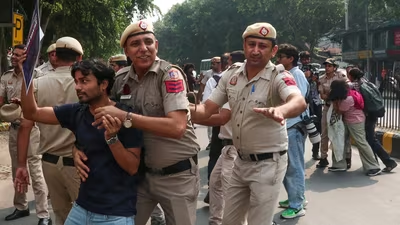
Delhi Police commissioner Anurag Kumar has defended the denial of permission for the Cockroach Janta Party (CJP)’s October 10 march and the preventive detention of protesters as “proportionate to the legitimate objective of maintaining law and order and preventing harm to persons and property”, asserting that the police administration could not have allowed breach of public order by an organisation with a recent history of mob violence, destruction of properties and incidents causing injuries to several people.
The affidavit forms part of the responses filed by senior officers after the Supreme Court issued contempt notices over the restrictions imposed around the protest. The police have sought discharge of the notice, maintaining that its actions were guided by the need to prevent disruption, violence and damage to persons and property. The commissioner sought to justify the restrictions by citing what he describes as the CJP’s repeated disregard of police directions and the conditions imposed for public demonstrations. The police claimed these gatherings choked central Delhi for hours, leaving commuters stranded. The commissioner alleged some participants turned aggressive, physically harassing police personnel and misbehaving with women officers. The commissioner invoked the distinctive security requirements for the national capital, pointing to the presence of Parliament, the Supreme Court, Rashtrapati Bhawan, diplomatic missions and other sensitive institutions. He argued that policing in Delhi required a careful balance between the right to protest and the need to protect public and private property, prevent injury and preserve the everyday movement of residents.
The police argued that those participating in the previous march were part of an unlawful assembly, seeking to justify the action taken against the mobilisation on October 10. The affidavit says the organisation had given a written undertaking for an earlier protest in June, including assurances that the gathering would remain peaceful, would not exceed 1,000 participants and would not turn into a march towards Parliament without prior permission. The police alleged the undertaking was subsequently breached and that the organisation later mobilised people for an unauthorised march towards Parliament on July 20. These allegations led to the police’s decision to deny permission for the October 10 mobilisation, according to the affidavit. The commissioner also relied on mobilisations on October 6, 7, and 8, alleging they created serious public-order problems in central Delhi.
In a counter-affidavit filed in response to contempt proceedings over alleged non-compliance with the Supreme Court’s directions on regulating public transport during the protest, the police commissioner described the July 20 march by CJP as “unauthorised, unlawful and illegal”. These included a march to the Election Commission office, a march from Janpath to Jantar Mantar, and another from Connaught Place towards Rajghat, according to the affidavit. More than a dozen police personnel were injured, the affidavit said.
