
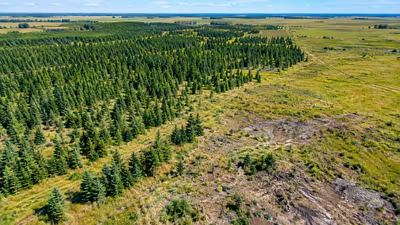
In a 2018 study published in Basic and Applied Ecology, Victoria Coffey and Rafael Otfinowski found that prairie land in Canada’s Riding Mountain National Park that once held spruce plantations didn’t come close to resembling untouched prairie 19 years after the trees were removed. Most of us think mistakes can be undone. You delete a file, you fix it; you spill your coffee, you clean it. Nature doesn’t always work like that.
Some trees were later taken out of some places to give the prairie space to regenerate itself. The authors conclude that tree removal alone is not enough to restore northern fescue prairies. Low-variety plant communities can persist and block recovery without active management. Most people think of tree planting as an easy way to help the planet. The study isn’t saying tree planting is bad. This was only one site in one park, so the results may not apply everywhere. But the message is useful for anyone who cares about nature: fixing a landscape can take far more than undoing the original change.
Various fescue prairies in the park in Manitoba were transformed into white spruce plantations between 1928 and 1950, according to the research. Fescue prairie is a rare type of land, and the researchers believe that nowadays it occupies less than 5 percent of its original habitat in North America . Because a grassland is a living system with its own plants, seeds, and soil life, it just shows that place matters.
It was an attempt to make up for trees that were logged before the park was created.
