
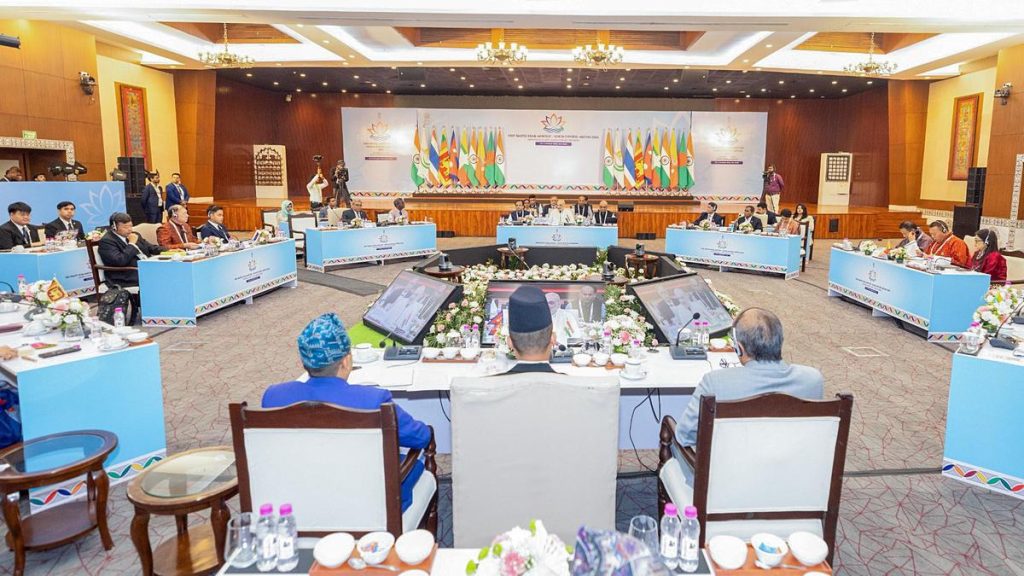
India hosted the first-ever meeting of the Home Ministers of the Bay of Bengal Initiative for Multi-Sectoral Technical and Economic Cooperation (BIMSTEC) countries on Tuesday (October 13, 2026), where the regional bloc adopted a declaration to counter radicalisation, violent extremism conducive to terrorism, prevent the misuse of new and emerging technologies for terrorist purposes, and tackle terrorist recruitment.
Bangladesh, the chair of BIMSTEC, was represented by Manzur Morshed Chowdhury, Senior Secretary in its Home Ministry, instead of Home Minister Salahuddin Ahmed, a key member in Prime Minister Tarique Rahman’s Cabinet. The grouping expressed condolences and solidarity with victims of terrorist attacks in member States and their families, as well as the governments of the affected States. It called for those responsible to be brought to justice in accordance with applicable domestic and international law and relevant UN Security Council resolutions. Union Home Minister Amit Shah highlighted five key areas of cooperation: drug control, counter-terrorism and legal cooperation, repatriation of fugitive criminals, cyber-security and cybercrime investigations, and institutional cooperation and capacity building. He called for a coordinated regional approach to combating illicit financial transactions and terror financing and stressed the need to strengthen cooperation among law enforcement, intelligence, and border management agencies.
During the BRICS summit hosted by India on September 12-13, there was no representation from Bangladesh either.
The “Delhi Declaration” signed by Bangladesh, Bhutan, India, Myanmar, Nepal, Sri Lanka and Thailand, also called for curbing terror financing through adherence to internationally agreed counter-terror financing and anti-money laundering standards, consistent with domestic and international laws. The declaration said the member states “strongly condemn terrorism and violent extremism in all its forms and manifestations, including cross-border terrorism, wherever, by whomsoever and for whatever purposes committed; reiterate our determination to prevent, combat and eliminate terrorism and violent extremism conducive to terrorism in a comprehensive and sustained manner, in accordance with the UN Charter and international law; and in this context, call for effective implementation of the sanctions measures of the UN Security Council, including of the 1267 Sanctions Committee”.
“India has always believed in sovereignty and peaceful resolutions to any dispute. We are committed to cooperating to face challenges emanating from International terrorism, organised crime and narco-trade,” Mr. “This is why regional cooperation is a must. Their strategy is changing; they are using encrypted communication, social media, drones, cryptocurrency and the dark web to recruit and propagate illegal activities. This is why real-time intelligence-sharing and cooperation is required to check these crimes. None of the member countries should shelter such criminals. We should cooperate in the extradition of such criminals,” he added. Mr. “India has extradited several criminals from across countries; we need cooperation in this aspect. A common protocol should be established for human trafficking and cyber slavery. In this direction, the proposed BIMSTEC national security database and information-sharing centre is a welcome step,” Mr. Mr. Mr. Mr. Shah held a bilateral meeting with his Nepalese counterpart Sudhan Gurung on the sidelines of the meeting.
Shah said. He said criminal networks run their operations beyond international borders and take advantage of regional lacunae. Shah flagged “human trafficking and cyber slavery” as grave concerns”. “Sharing of actionable intelligence should be a priority among BIMSTEC countries,” he said. Shah said, highlighting counterterrorism and law enforcement as key areas of cooperation. Shah said that India believes that drug trafficking is essentially “death trafficking” and that there is nothing “golden” about the “Golden Triangle”, referring to the narcotics-trafficking region associated with Thailand and Myanmar. He said drug trafficking threatens youth, society, culture, and the future of coming generations, and it cannot be tackled with the efforts of a single country and requires a “whole-of-region” approach. Shah said proceeds from drugs provide financial power to organised crime and terrorism. He said the diversion of precursor chemicals and transactions through the dark web further complicate this challenge. The declaration called for “early finalisation of texts of the conventions on extradition, transfer of sentenced persons, and convention against trafficking in persons, as well as a standard operating procedure for rescue, repatriation and reintegration of victims of human trafficking”.
