
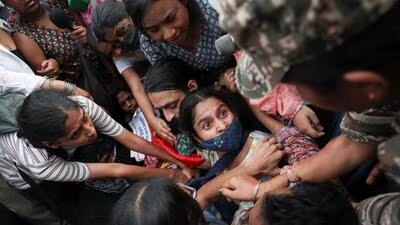
The Delhi high court on Tuesday sought the Centre’s response in a petition seeking implementation of Standard Operating Procedures (SOPs) to regulate protests and prevent disruptions to traffic and businesses amid demonstrations demanding the resignation of chief election commissioner (CEC) Gyanesh Kumar.
Senior advocate Sacchin Puri and Sanjay Poddar, appearing for the petitioners, submitted that the protests were disrupting business activities and urged the court to direct that demonstrations be held at designated sites to ensure that professionals and businesses are not affected. The petition stated that the Supreme Court, in Mazdoor Kisan Shakti Sangathan v. Union of India, had directed the Commissioner of Police to formulate a regulatory mechanism for protests. Following the directions, binding conditions were laid down for demonstrations, including a prohibition on blocking traffic, office gates and arterial roads.
“In the meantime, we direct the respondents to take instructions in the matter,” the court said in the order.
Apart from the petitions seeking implementation of the SOPs governing protests, the court also heard a plea filed by National Students’ Union of India (NSUI) president Vinod Jhakhar, seeking an investigation by a Special Investigation Team (SIT) into the alleged assault on members of the public by anti-social elements during a protest demanding CEC’s resignation on October 10. The plea sought the identification of those involved and appropriate legal action against them. The court also heard a petition filed by advocate Anshika Tripathi challenging the closure of Jantar Mantar as a protest site and raising concerns over alleged disruptions, including the closure of metro stations and disruption of railway services.
In Jhakhar’s petition, the court permitted Centre to file preliminary objections concerning the maintainability of the petition, while in Tripathi’s petition, the court directed her to produce the copies of the petition pending before the Supreme Court on the same issue.
