
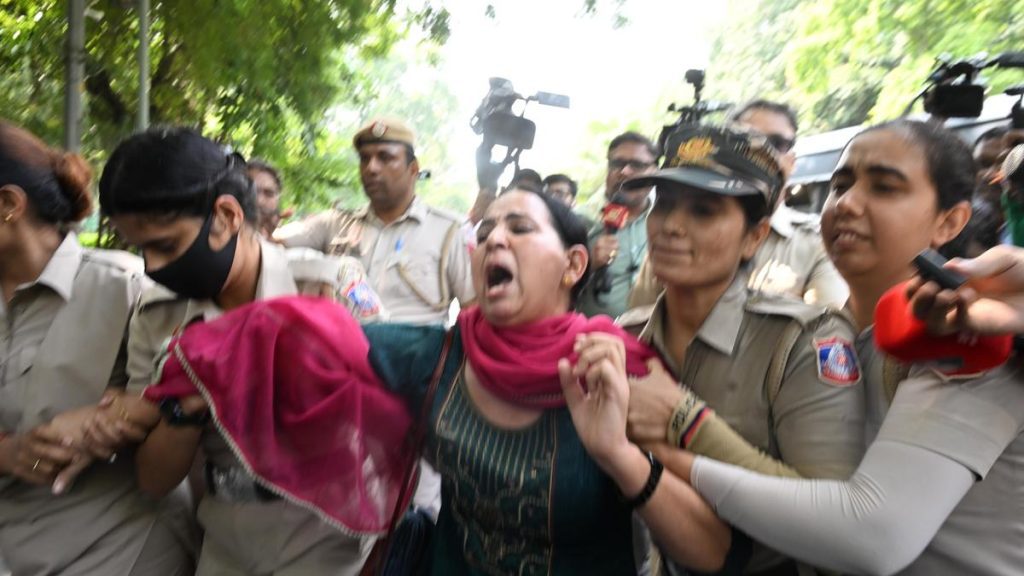
The Union government informed the Supreme Court on Tuesday (October 13, 2026) that its response to petitions alleging illegal detentions, shutdown of public and rail transport, including Metro service, in Delhi on October 10 is “ready” but needs more fine-tuning.
A three-judge Bench headed by Chief Justice of India Surya Kant extended the time for the government to file the reply affidavit by Thursday (October 15).
Solicitor General Tushar Mehta, for the Centre, said he had gone through the prepared affidavit. It was final, but he wanted to make it “more comprehensive”. Separate petitions filed by organisations of media professionals, including Free Speech Collective and Network of Women in the Media, India, said the violence visited upon journalists, both on October 10, 2026 and October 11, 2026, were “not merely isolated obstruction, but an asserted course of police action comprising unlawful detention, forcible removal, physical assault, manhandling, intimidation, disregard of press credentials and the calculated exclusion and removal of journalists from places where public power was being exercised”. The petition, filed through Aarthi Rajan, said “unless restrained by law and judicial review, such conduct converts the constitutional freedom of the press into a paper guarantee”. Network of Women in Media, India, said the “physical handling, intimidation, forcible removal and detention of women journalists in particular interferes not only with newsgathering and freedom of the press, but also with their dignity, bodily integrity, personal liberty and equal ability to participate in the profession”.
“A free press must be able to approach, observe, question, record and report the exercise of public power, especially during protests, dispersals, arrests and crowdcontrol operations. If the police may equate observation with participation, disregard credentials, seize the reporter’s person and remove the reporter from the scene, the resulting account is necessarily filtered by the very authority whose conduct requires independent scrutiny. The chilling effect is immediate: journalists retreat, evidence disappears, public knowledge contracts and democratic accountability is defeated,” the petitions submitted.
Senior advocate Nitya Ramakrishnan said “documentary proof of students being abused in police stations” have been placed on record before the Supreme Court, and should also be taken up for hearing on October 15, 2026.
