
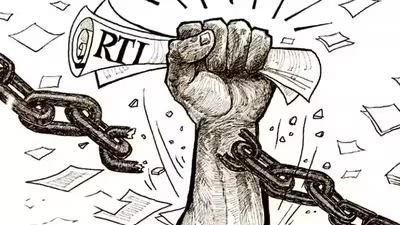
Twenty-one years ago, on October 12, 2005, the Right to Information (RTI) Act came into force, giving every Indian citizen the legal right to question the state. The law grew out of a movement that began in the villages of Rajasthan, where the Mazdoor Kisan Shakti Sangathan (MKSS) held public hearings to compare official records with what villagers knew from the ground.
Then governments started digitising information, and as they did, they put it behind admin logins that only officers can see. The bulk of what matters to citizens is behind logins that a Joint Secretary, Deputy Secretary or BDO can access, but others cannot. That is why we have pushed to remove admin logins. The amendments made it worse by making commissions far more subservient to the government. We have seen the same debate around the appointment of election commissioners. For information commissioners too, the formula is the Prime Minister, the Leader of Opposition and a Cabinet Minister chosen by the Prime Minister. The bottom line is how independent you make the institution, in appointments and in functioning. They have made it more subservient to the executive, which is terrible. It is terrible that the Act has not been implemented. There should be accountability for every attack and every death. If an RTI user is attacked while seeking information or in the follow-up, it should be the state’s duty to not just inquire into that case but audit the entire institution. If someone has been murdered, something is seriously wrong with the whole office. If a sarpanch attacks someone who asks questions about a road, the whole panchayat should be audited by state government auditors. The attack is meant to silence the person, so the response should be to investigate even more, so they know it can cost them much more.
Take the Jan Soochna portal in Rajasthan, which covers 169 departments and 330 schemes, with government expenditure and transactions disclosed online in real time. It has had about 37 crore visits since 2019 and over 50 crore pieces of information downloaded. Because people get the full audit trail of their applications, even if a tiny percentage of that would have become RTIs, think of how many RTIs it has prevented,.
RTI said that what was hidden under the Official Secrets Act would now be made public. That is contrary to the RTI Act, which said that as you digitise, you should make information public. “Open data” is a misnomer.
