
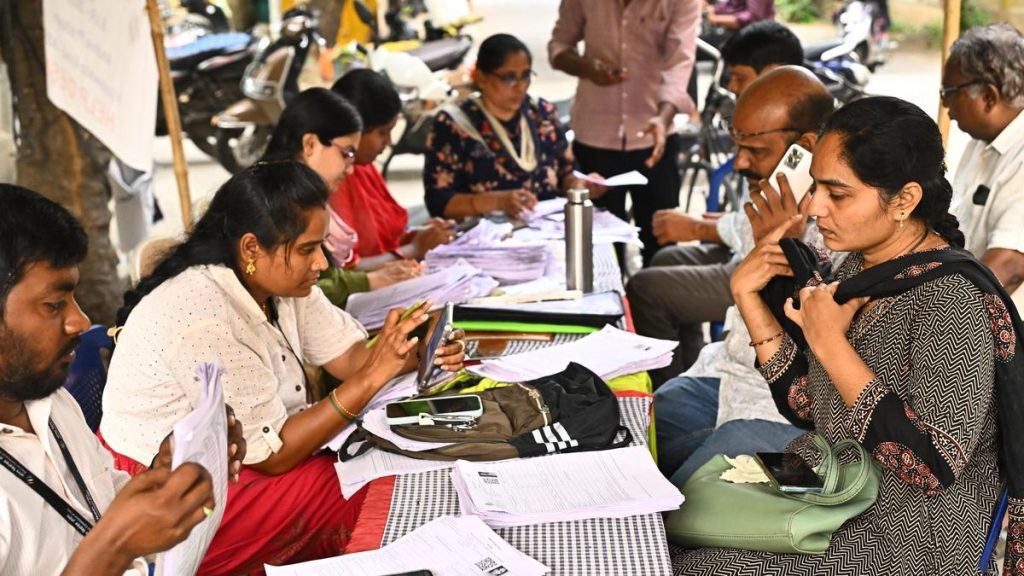
There have been renewed protests against the special intensive revision (SIR) process. Former Election Commissioners and Supreme Court judges have also questioned the exercise in its current form. As a counter, there have also been former judges and bureaucrats who have supported the current SIR process.
Where an enumerator reported to the supervisor that a particular house had been locked during repeated visits, the supervisor was required to visit the house to verify this. First, the SIR required enumerators to conduct door-to-door verification using a preliminary list generated from the then existing roll. Elected Panchayat members could be voluntarily involved for assistance during the process. Second, detailed guidelines were provided for supervision. Third, with regard to citizenship, the guidelines specified that the onus of proof of citizenship lay with the applicant who applied for inclusion of his/her name in the electoral roll for the first time. If an entire family had shifted, supervisors had to personally verify such cases. Since all areas were enumerated at the same time, the shifted electors were enrolled at their new address during the same exercise. The Chief Electoral Officer then acted as a clearing house to ensure that the old entry was deleted from the final roll. Only those missed at their new address had to apply during the claims and objections period. Finally, the guidelines categorically mentioned that claims and objections presented in bulk by any individual/organisation or political party should be refused and rejected summarily. The final roll was to be prepared only after all claims and objections had been duly disposed of. The key issues in the current SIR process are summarised here. First, the electors who could not be found, or who did not return or fill in the form, were excluded from the draft electoral roll, even if they had voted in previous elections. Second, the requirements of supervision of the current SIR are not as elaborate as the last SIR. Third, the requirement for electors to trace themselves or a parent to the electoral rolls prepared during the last intensive revision, nearly two decades ago, or to produce documents to establish citizenship, is perceived as shifting the onus of proving their eligibility for inclusion in the rolls onto the common electors. In order to avoid the filing of such objection forms in bulk on unsubstantiated grounds, the ECI, only on October 9th, had issued instructions setting a cap on the number of objection forms that can be filed by an individual.
Section 21(3) of the Representation of the People Act, 1950 (RP Act) authorises the Election Commission of India (ECI) to carry out a special revision of the electoral roll for ‘any’ constituency or part of a constituency in such manner as it may think fit. The ECI had decided in June 2025 to carry out an SIR exercise across the country, starting with Bihar in Phase I. Phase II, held between October 2025 and February 2026, covered nine States and three Union Territories. Phase III, which commenced in May 2026, covered 16 States and three Union Territories. In May 2026, the Supreme Court held that the ECI was well within its constitutional mandate to conduct an SIR for ‘many’ or ‘all’ constituencies in a State. The Special Intensive Revision has been conducted on eight different occasions in the past, with the last one taking place between 2002 and 2004. They key guidelines issued in May 2002 for the last SIR, which have a bearing on the issues raised with respect to the current exercise, are summarised here. Supervisors were required to randomly check at least 25% of the households covered by enumerators. Senior officers — Assistant Electoral Registration Officers (AEROs), EROs and District Election Officers — were required to check a minimum of 12%, 5% and 2% of the households, respectively. However, they also referred to the guidelines laid down by the Supreme Court in Lal Babu Hussein and Others (1995) which require the ERO to attach adequate ‘probative value’ to an applicant’s presence in the existing roll. Under normal course, they would be required to file Form 8 (for shifting residence) at their new place of ordinary residence. Otherwise, if they are missed out, they would be required to apply afresh through Form 6, which is meant for new electors. This goes against the ECI’s own Manual on Electoral Rolls (2023) which requires that a shifted elector who can be traced should be served a notice, and in cases where they cannot be traced, a notice must be pasted at their last known address in the presence of adult witnesses and the name should be deleted only after the notice period expires. The notification before Bihar’s SIR mandates 10% random verification by supervisors and only requires regular monitoring meetings by ERO with AEROs, Supervisors and booth-level officers (BLOs) to ensure that work done is not superficial. Fourth, software generated ‘logical discrepancies’, including spelling differences, more than six voters linked to one ancestor and parent-child age gaps outside the range of 15 to 45 years, among other factors, resulted in the arbitrary exclusion of lakhs of eligible voters. Finally, there have been reports of filing of Form 7 (objection forms) in bulk by individuals for removing the names of electors from rolls at various places. Apart from these procedural issues, legal concerns have also been raised regarding the validity of the declaration attached to Form 6 (used for enrolment of new electors), the use of Form 6 for re-enrolment of electors deleted from the draft rolls, and the cumbersome procedure for the disposal of a large number of appeals.
Fourth, electors who had shifted residence were treated like a “transfer” rather than a deletion. Their entries in the preliminary list were not erased but struck through and marked “S” and enumerators had to record who reported the shift, besides the constituency or address to which the elector had moved. Unlike in 2002, those recorded as “shifted” were not enrolled at their new address through the same exercise.
The SIR process has resulted in the deletion of around 13.3 crore voters across the three phases. A significant portion of the 9.5 crore voters (71%) fall under the ‘absent, shifted and others’ category. Many of these 9.5 crore voters could be eligible for re-enrolment on completion of the SIR process. As per the proviso to Section 21(3) of the RP Act, the existing pre-SIR rolls can continue to remain in force and be used for upcoming State elections, pending the completion of SIR rolls after due process. (Rangarajan R. is a former IAS officer and author of ‘Courseware on Polity Simplified’.
Around 2.7 crore (20%) were deleted due to death and 1.01 crore (8%) were flagged as duplicate entries. The right to vote is a crucial edifice on which our democracy rests. Considering the renewed issues that have been raised surrounding the process, there should be a detailed audit of the rolls that have been finalised so far. Eligible claims for re-enrolment should be expedited, including through home visits, and roll updations. Door-to-door enumeration should be the prescribed procedure for States where SIR is ongoing, and electoral rolls should be finalised only after the disposal of all claims and objections. He currently trains at Officers IAS Academy. Views expressed are personal.)
