
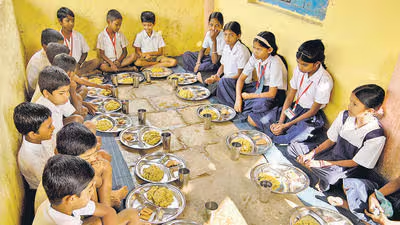
The issue was discussed at a joint meeting of the school education department and women and child development department chaired by chief minister Devendra Fadnavis on Thursday to review the mid-day meal scheme and nutritious food supply scheme in anganwadis (creches). MUMBAI: The Maharashtra government is considering extending the school mid-day meal scheme to students up to Class 10 from the current Class 8 while also promoting locally available protein-rich foods, millets and regional cuisines to ensure fresh, nutritious meals.
These include schools run by the state and central governments, local self-government bodies, and private institutions receiving full or partial grants. He also ordered district collectors to convene meetings of district-level nutrition committees and asked that zilla parishad chief executive officers coordinate the process. School education minister Dadaji Bhuse suggested expanding the coverage of centralised kitchens and providing funds to gram panchayats for supplying meals locally. He also urged the state government to seek permission from the Centre to reduce the proportion of rice and increase the use of other grains in school meals. To this, Fadnavis responded that centralised kitchens should be used wherever feasible while remote and tribal areas could rely on local arrangements through gram panchayats. Women and child development minister Aditi Tatkare agreed on points such as empowering district-level nutrition committees to draw up menus and provide freshly prepared food with locally appropriate ingredients instead of relying on premixes or fortified food products.
The school education department implements the Pradhan Mantri Poshan Shakti Nirman Yojana in 85,206 eligible schools across the state, according to information presented at the meeting. The scheme currently covers students from Class 1 to Class 8. Under central government norms, students from Classes 1 to 5 are provided midday meals containing 450 kilocalories and 12 grams of protein. Students in Classes 6 to 8 receive meals containing 700 kilocalories and 20 grams of protein. To introduce variety into the menu, the department has finalised 12 recipes, including different types of pulao, khichdi, usal (pulses) and dal-rice. Fadnavis ordered both the departments to formulate a joint policy to ensure that students received fresh, nutritious and quality meals on time and examine the feasibility of extending the scheme from Class 8 to Class 10. She said her department would assign ISKCON the responsibility of supplying nutritious meals to 30 anganwadis in urban areas, whose number could be increased after assessing the effectiveness of the initiative.
“Local food habits and students’ preferences should be taken into account while considering nutritious alternatives, including millet-based dishes,” he said. Self-help groups could also be entrusted with meal distribution, he said.
