
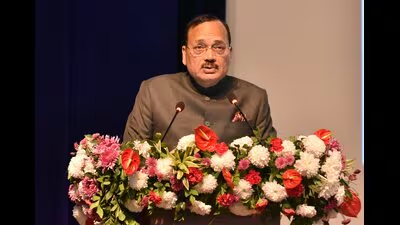
Chief Justice of India (CJI) Surya Kant has constituted a committee, headed by Supreme Court judge Justice KV Viswanathan, to address the mental and physical well-being of judicial officers across the country, coinciding with World Mental Health Day.
The other members are Savita Malhotra, former dean and professor at the Postgraduate Institute of Medical Education and Research (PGIMER), Chandigarh; Rajat Mitra, psychologist and co-founder of the Swanchetan Society for Mental Health; advocate Mrinal Kanwar; and Aarti Singh, registrar at the Supreme Court’s Centre for Research and Planning. The committee will provide a structured institutional mechanism to identify and address issues affecting the professional and personal well-being of judicial officers.
The Standing Committee on Judicial Well Being will have four other members, including medical experts, and will seek to support judicial officers dealing with heavy caseloads, prolonged working hours, complex decision-making, administrative pressures and emotionally challenging cases, according to a Supreme Court release. “The initiative marks an important step towards recognising judicial well-being as an essential component of an effective, independent and sustainable justice delivery system,” the Supreme Court release said. “Its responsibilities will include identifying areas requiring institutional intervention, facilitating coordination on welfare measures, developing appropriate guidance and periodically reviewing initiatives undertaken to support judicial officers,” the release added. “By creating a dedicated mechanism for studying, addressing and periodically reviewing judicial well-being, the Supreme Court seeks to promote a healthier and more supportive working environment for judicial officers,” the release said.
The Supreme Court’s Centre for Research and Planning had earlier undertaken research on occupational stress, workload, mental and physical exhaustion, staffing shortages, infrastructure limitations, administrative responsibilities, transfers, work-life balance and the availability of institutional support among judicial officers.
