
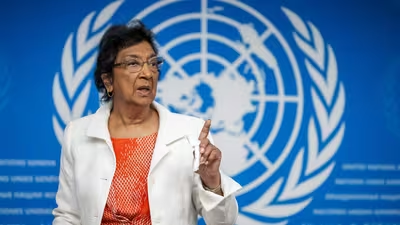
Born to Indian parents of Tamil descent in Durban and raised in the slums of Clairwood, KwaZulu-Natal, Navanethem ‘Navi’ Pillay grew up in a home without books, newspapers or a radio. Poverty and discrimination shaped her early years, Pillay has mentioned in interviews over the years.
Pillay’s father worked as a bus driver, while her mother was an uneducated homemaker who had been denied the opportunity to attend school. Her maternal family’s struggles stretched back generations. Her grandfather had been brought to South Africa as an indentured sugarcane labourer by British plantation owners. She also remembered a teacher discouraging her ambition by suggesting that her father must have considerable money to send her to university. The opportunity eventually came through the support of her community. Residents contributed whatever they could, including small coins and two-rand notes, after the school identified her potential and appealed for help with her university education. Graduating with a BA LLB from the former University of Natal, now the University of KwaZulu-Natal, did not end Pillay’s struggles. The university registrar refused to help, saying she could not exercise authority over white staff, and suggested that she consider teaching instead.
At 24, she found that securing articles at a law firm was difficult.
“I tell this story all over the world and it’s very new to them – it’s not new to South Africans – we all come from deprivation, discrimination and poverty,” Pillay, the former United Nations (UN) High Commissioner for Human Rights, was quoted as saying in a blog published by the University of the Witwatersrand, where she was awarded an honorary doctorate. “That question is so loaded, because you could see the underlying thinking there – that ‘you’re black, you’re poor, you’re a woman, you come from apartheid South Africa’,” she told University of the Witwatersrand in an interview, recalling how people were intrigued that someone raised under apartheid could pursue higher education. “Thinking back, I could see that what moves us is confidence and faith in ourselves, a willingness to work hard, and parents who appreciate the value of education,” she said, according to University of the Witwatersrand. “Twenty-five years later, there I was experiencing those same obstacles,” Pillay told the University of the Witwatersrand.
