
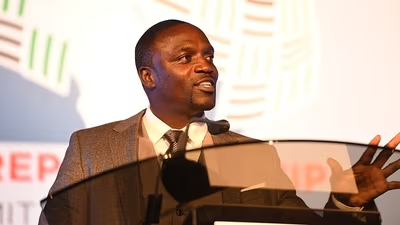
According to a 2019 case study titled ‘Sustainable energy solutions: Akon Lighting Africa’ published in DECISION, he co-founded Akon Lighting Africa, a solar initiative to provide electricity to rural areas in 2014. The initiative says it had installed solar solutions in 14 African countries within a year. Akon is known to most people for his music, but fewer know about his work on solar power. The case study describes it as a celebrity-run project.
Tracking SDG 7: The Energy Progress Report 2026 , a joint report by the IEA, IRENA, the UN, the World Bank, and the WHO, shows that 655 million people in the world still live without electricity, with more than 560 million of them in Sub-Saharan Africa. In 2024, 92 percent of people had access globally. The report also finds the number of rural people without power in that region increased from 376 million in 2010 to 447 million in 2024. Reaching 14 countries sounds exciting, but it’s not without challenges.
The need was huge. That sounds high, but progress has run out of steam, leaving sub-Saharan Africa and rural areas behind. For many readers, steady power is simply part of daily life. The numbers show how uneven access remains around the world. The study considers the challenges of operating in different countries. The paper also includes a table profiling the electricity and renewable-energy status of the countries where the project works, showing how conditions vary by location. Using a business framework, the authors show how the project can use its strengths to help more people get electricity . Rapid growth is only part of the challenge. Making the plan work in each place is another matter, and the paper treats both sides as part of the story. Akon’s project is one example of how a familiar name can help shine a spotlight on an energy problem. However, the numbers show that a single project probably isn’t going to close such a vast gap.
