
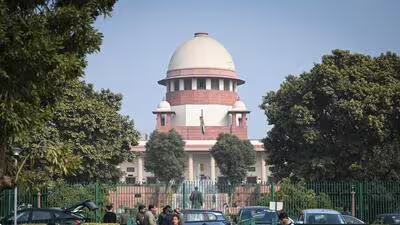
The Supreme Court has directed all states to promptly upload road-accident data on the Electronic Detailed Accident Report (eDAR) portal and interlink VAHAN, SARATHI, eDAR, and the Insurance Information Bureau (IIB) databases to allow seamless cross-verification of accident reports, vehicle and insurance records, and past claims.
This could enable real-time matching of an accident claim with police records, the vehicle’s registration details, the driver’s licence particulars, insurance coverage and prior claims history. The eDAR portal, operated by the National Informatics Centre, has been created to digitise detailed accident reports and facilitate motor-accident compensation claims. But the court noted that only a few states had begun uploading data on it. A claim could be checked against the original police-recorded accident particulars, including the vehicle, location, date, driver and victims. It could also be cross-verified with the relevant insurance policy and with claims history across insurers. Discrepancies, such as the same vehicle repeatedly cited in unrelated accidents, a mismatch in the identity of the driver or vehicle, or an accident claim unsupported by a contemporaneous eDAR record, could be flagged early for investigation.
It ordered all states to ensure data concerning the issue before it is uploaded on eDAR “without any delay”. The court order, released on Thursday, aims to turn fragmented databases maintained by the police, transport authorities, insurers and other agencies into an integrated digital trail for each accident.
The wider linkage with the hit-and-run compensation mechanism and PM-RAHAT — the cashless-treatment scheme for road-accident victims, could also speed assistance for genuine victims. A contempt notice was issued to Vaibhav Goyal, managing director and chief executive officer of Navi General Insurance Ltd. PM-RAHAT is implemented through a technology framework that uses eDAR and is meant to provide cashless treatment of up to ₹ 1.5 lakh per victim for up to seven days after an accident. The company said a Supreme Court notice received on April 18 had not been brought to the attention of its officers and that some responsible persons had been suspended.
But the court rejected the apology as “cosmetic and not heartfelt”, noting that no action had been taken against the persons allegedly responsible.
It gave the Centre, states and other authorities four weeks to complete the exercise and file compliance reports.
The order is part of the court’s continuing proceedings on alleged large-scale fraud in motor accident insurance claims, for which it had earlier directed every state to establish a dedicated special investigation team (SIT).
