
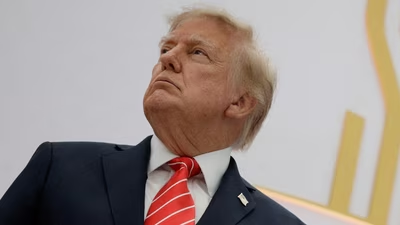
The Trump Organization sought permission to hire 36 temporary foreign workers for its Virginia winery at $13.90 an hour. This rate is nearly nearly $2 less than the previous year’s rate. The application came weeks after President Donald Trump ’s administration lowered minimum wage calculations for certain foreign agricultural workers.
The filings show the contrast between Trump’s immigration crackdown and his company’s continued reliance on overseas labor. On the contrary, Trump administration has since the beginning of his term targeted the H-1B visas. These, unlike those his businesses use, are for highly skilled workers in specialized fields such as engineering, accounting and the arts.
The winery, operated by Trump Vineyard Estates LLC near Charlottesville, sought workers for grape and apple production from February through October 2026, according to the US Department of Labor’s seasonal employment database. Forbes reported the application on January 12, citing Labor Department records. The requested wage was $13.90 an hour, compared with $15.81 in 2025. Workers previously employed by the winery could receive $16.16 an hour if they returned in 2026, according to the filing. The Trump Organization has sought to bring at least 2,069 foreign workers into the United States since 2008, according to the records reviewed by Forbes. Trump also recently imposed a $100,000 payment on many H-1B visa petitions.
The department had indicated that preparing a replacement could take several months. The court rejected a longer delay and required the government to provide updates on its progress. The ruling challenges the administration’s approach to setting agricultural wages, although it does not establish that the Trump Organization violated labor or immigration laws. The winery’s hiring application and the broader legal dispute remain separate matters.
The Economic Policy Institute estimated that the revised methodology could reduce total US farmworker pay by about $3 billion annually, or roughly 9% of wages. The United Farm Workers and 18 individual farmworkers subsequently challenged the rule in federal court, according to Forbes.
