
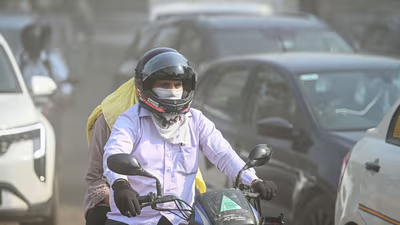
A 15-member expert committee constituted to suggest measures to abate vehicular emissions in Delhi-NCR has suggested phasing out all vehicles running on internal combustion engines (ICE) to zero-tailpipe emission vehicles by 2040, as per a report it submitted to the Commission for Air Quality Management (CAQM).
It recommended phasing out BS-IV vehicles by 2030, BS-VI two-wheelers by 2035 and BS-VI four-wheelers by 2040. Also Read I Faster breathing, more pollutants inhaled & the science behind CAQM’s advice to reschedule school sports in winter It also recommended stopping registration of ICE four-wheelers from 2031. The committee, headed by IIT Madras professor Ashok Jhunjhunwala and having representatives from the ministry of road transport highways, the ministry of heavy industries, Automotive Research Association of India (ARAI) and NITI Aayog , was constituted in December 2025 by CAQM. The report, submitted to CAQM on August 18 and accessed by HT, suggests a similar plan across the Indo-Gangetic plain region, may be considered too, arguing for the need to bring vehicular emissions down to zero for reducing air pollution in the larger air-shed. The report stated that of the active and fitness-approved fleet of 22.1 million vehicles across Delhi-NCR, EVs account for only 360,000 vehicles (1.6%), while nearly 57% of the fleet is BS-IV or older. “More importantly, the emissions profile (the latest emission-factor made available by ARAI) is heavily skewed towards older vehicles: BS-I to BS-III vehicles constitute around 30% of the fleet but account for nearly 74% of particulate matter emissions, while BS-IV vehicles contribute a further 19%. In contrast, BS-VI vehicles constitute over 41% of the fleet but contribute only around 7% of PM emissions. Also Read I Gurugram schools face air pollution 5.5 times above safe limits, study finds To make the transition possible, however, the expert committee has argued for setting a clear transition timeline for new vehicle sales, giving consumers, OEMs, financiers and charging-infrastructure providers sufficient visibility to plan ahead. For the winter season, specifically, the committee has proposed temporary restrictions, including a pilot for this winter, wherein BS-IV vehicles may be banned between November 1 and January 31 in Delhi-NCR.
The committee put forth electric vehicles as a solution, which will also reduce reliance on oil imports, and proposed timelines for gradual phasing out. For currently operational vehicles adhering to emission norms below the BS-IV standards, it recommended an immediate exit from Delhi-NCR, in line with the Delhi EV Policy guidelines. “We have already ordered phasing out of light goods vehicles and three-wheelers based on this report. This demonstrates that the quickest pathway towards zero tailpipe emissions requires prioritising the removal of older vehicles immediately, while giving a little more time for BS-VI vehicle removal,” read the committee’s report. This includes providing scrappage incentives to switch to an electric vehicle.
CAQM said it has looked at the proposal and is reviewing it. Other aspects are also being reviewed and considered accordingly,” said a senior CAQM official. The plan also emphasises the need to enact “right to charge” laws across Delhi-NCR, to establish statutory rights for EV owners to install a 3kW, 7kW or 11kW AC charger at their parking spaces, including in basements, subject to compliance with established safety norms. The committee said that phasing out of these vehicles in Delhi-NCR must not translate to moving them to other cities in the air shed region. “Mechanisms should be devised to prevent the transfer of high-emitting vehicles from Delhi-NCR to other highly polluted regions,” it states.
