
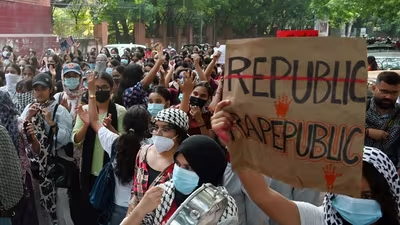
The Supreme Court on Thursday ordered enhanced police patrolling around schools, colleges, universities and coaching centres across Delhi, mandated stringent verification of drivers and assistants operating public transport and app-based cabs such as Ola and Uber, and directed authorities to ensure real-time monitoring of vehicle tracking and SOS systems as part of a sweeping preventive policing regime to curb sexual offences in the national capital.
Senior police officers will have to regularly meet beat personnel and review local vulnerabilities, emerging patterns of delinquency and the effectiveness of patrolling, while existing protocols governing the deployment and halting of police control room vans will also have to be reviewed. The commissioner of police has been directed to submit the squads’ weekly reports for the preceding three months, along with a consolidated assessment showing where and when they conducted drives, their frequency, the action taken and its follow-up. The court directed the chief secretary and commissioner of police to remain the deponents of all affidavits reporting compliance throughout the proceedings. The court’s directions also cover civic conditions that can create vulnerabilities. Authorities have been ordered to identify trucks, heavy vehicles and other vehicles habitually parked in a manner that obstructs visibility or creates blind spots and to remove them. Unauthorised liquor shops and establishments have also been ordered to be identified and dealt with, with beat officers directed to remain vigilant about illegal liquor supply and crowding or loitering around such establishments.
The directions came in continuation of the court’s September 28 order after it took suo motu cognisance of a series of recent rape incidents in Delhi-NCR.
The court also called for dedicated command centres or “war rooms” to monitor police patrolling and CCTV infrastructure, and ensure immediate field-level response to vulnerabilities, incidents and public complaints, while making the Delhi government and police chief directly accountable for implementing the measures. A bench of justices JB Pardiwala and K Vinod Chandran pointed out that that the exercise was aimed at ensuring the existing and newly mandated safeguards translated into “visible, timely and verifiable action” on the ground. It directed the chief secretary of the Delhi government and the commissioner of police to file periodic compliance reports and warned that the two officers would be made “personally answerable” if the court found that its directions were not being implemented with the seriousness required. The court said its endeavour was two-fold – to immediately identify and address deficiencies in existing mechanisms for crime prevention and emergency response, and to make the authorities identify any gaps in policy or its implementation. The court’s emphasis on accountability extended to the police’s existing “Shishtachar Squads”, constituted under a March 2025 Delhi Police circular to deal with eve-teasing and sexual harassment in public spaces. It specifically said that if its directions were not complied with, implemented or accorded the required seriousness, the two officers would be made personally answerable.
The court accordingly directed immediate enhancement of beat patrolling across Delhi, with particular focus on educational institutions and other areas identified as vulnerable through the mapping exercise ordered earlier.
