
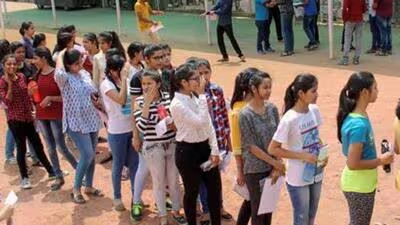
Between 2013 and 2020, women accounted for only 7% to 9% of Bachelor of Technology (BTech) students at the prestigious Indian Institutes of Technology (IITs), even though they comprised 28% to 29% of undergraduate engineering students across India. The proportion rose significantly to nearly 20% by 2020 and has remained around that level since, thanks to the Supernumerary Seats Scheme (SSS), which changed the odds of women studying at the 23 IITs.
Students say the scheme is creating a self-reinforcing effect by increasing the visibility of women in engineering. “The scheme is creating a community of women engineers who will further motivate other girls to pursue higher studies in engineering. The impact In 2026, women were allotted 3,814 of 18,861 IIT seats, or 20.22%, compared with 20.15% in 2025. Of these, 3,777 were allotted through women-only seats and just 37 through the gender-neutral pool. The numbers reflect the impact of SSS in increasing women’s representation in IIT undergraduate programmes to 20%.
Akshaya Jha, a fourth-year BTech student at IIT (ISM) Dhanbad, said the SSS is very helpful in motivating women to aim to study engineering at the IITs.
The study found that the scheme appears to be doing more than simply increasing women’s headcount. It is changing the branches high-ranking women choose. The study found post-SSS rank gaps between women-only and gender-neutral seats are smallest for traditionally male-dominated programmes. It suggested that high-ranking women are increasingly opting for branches such as computer science, electrical and mechanical engineering. The study argues that the presence of more women in IITs can alter perceptions about engineering as a male-dominated field and encourage other women to consider the institutions.
A study by Nandana Sengupta and Ravinder Kaur of IIT Delhi and University of Houston’s Rohit Munshi, published in November 2025 in the Springer journal Higher Education, found that before SSS, women constituted 11% to 13% of JEE (Advanced) qualifiers.
The study noted that the finding warrants a re-examination of earlier assumptions about gendered preferences in engineering.
