
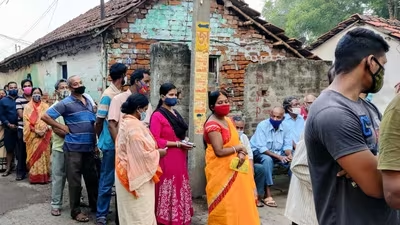
The five West Bengal constituencies where the most names were struck off the voter rolls in the Special Intensive Revision (SIR) ahead of the 2026 assembly election were all won by the Trinamool Congress (TMC), according to officials who cited Election Commission of India (ECI) data amid protests by the Opposition and activists over the process.
The state went on to record a turnout of 93.71%, its highest since Independence. The figure surpassed Tripura’s 93.61% from 2013, until then the highest for any state. Votes cast also rose from 2021, though the roll was smaller.
The Bharatiya Janata Party (BJP) routed the TMC in a historic verdict and formed the government in the eastern state for the first time, prompting Opposition allegations that SIR had a bearing on the outcome.
Based on this data, it would not be right to infer that the SIR process nudged a particular political party to victory. At the same time, the data points to a layered impact of the voter-roll revision that calls for more nuanced analysis. The commission has rejected the charge and called the revision a necessary exercise to ensure an accurate roll. The INDIA bloc, led by the Congress, and the Cockroach Janta Party (CJP ) are separately holding protests calling for Chief Election Commissioner (CEC) Gyanesh Kumar’s resignation, after a news report brought some decisions of the poll body under scrutiny and suggested that Kumar and two Election Commissioners (ECs) were not in agreement over several issues.
Kerala recorded 79.53%, level with Brazil and South Korea. Bihar, the lowest of the six at 67.25%, was still ahead of the United States, the United Kingdom and Japan. India’s own turnout in the 2024 Lok Sabha election, 65.79%, sits in the middle of the list. Another Opposition allegation is that 13.39 crore voters have been disenfranchised through the SIR process.
The officials cited the figures as the commission faced renewed charges of what the Opposition calls “vote chori” over the revision, which removed 90,83,345 names from a roll of 7.66 crore in the state. The commission has said differences among officers are normal and that all its actions were lawful.
The poll body has clarified that a total of 95.40 crore voters were reviewed during the three phases of the SIR exercise. The ECI has rejected the characterisation of all these voters as disenfranchised, saying eligible electors can apply for review and inclusion in the rolls.
Of them, 13.39 crore voters were categorised under ASDD, which means “Absent, Permanently Shifted, Dead or Duplicate”, along with some other categories.
