
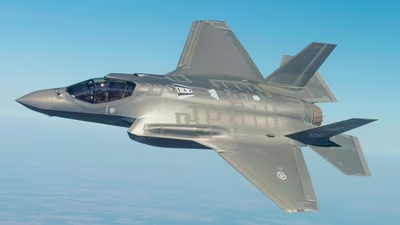
The worker had missed the warning sent over mail not to route the shipment through Hong Kong , Bloomberg reported . A missed email by a United Parcel Service Inc. employee ended up in China getting hold of the parts from an F-35 stealth fighter jet .
The Pentagon and State Department launched investigations after the incident, and lawmakers demanded that the global supply chain of US armaments be reviewed to ensure such instances don’t repeat. The parts that China got a hold of were coated with radar-absorbing material to enhance stealth capabilities. They were being sent to the US for possible repair or disposal in late May, the report added. The Pentagon has distanced itself from the matter, and downplayed the importance of the parts, calling them ‘unserviceable’.
As per the report, China has targeted the F-35 for years in espionage efforts, as it remains the world’s most advanced warplane as well as the most expensive US weapons program, historically speaking.
It was mistakenly sent via Hong Kong in an attempt to speed up the delivery, Bloomberg further reported. Freight forwarder firm DSV A/S had sent the email which said the parts, including an F-35 cockpit canopy and weapons-bay door coated in radar-absorbing material, must in no way pass through certain countries in compliance with the US International Traffic in Arms Regulations (ITAR). DSV reportedly sent the email on the ITAR designation, as needed by US regulations, on working on behalf of F-35 developer Lockheed Martin Corp. Pentagon officials had earlier outlined details about the diverted shipment on September 29, when matting with staff members of the House foreign affairs and armed services committees.
These regulations are in place to keep sensitive US weapons technologies from falling into the hands of their adversaries, as it happened in this case. The shipment containing warplane parts was supposed to go to San Francisco via South Korea and Taiwan. They are both US partners, but this shipment was late in leaving Australia. The email may gone through a different IT system than the one the UPS agent used used, as per the report. DSV spokesman Stephan Ghisler-Solvang and UPS spokesman Malcolm Berkley declined to comment on the matter, which has become an embarrassment for the Pentagon and Lockheed Martin, as per Bloomberg.
