
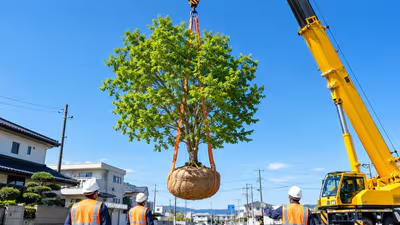
In most places, if an old tree is in the way of a road or a building, they probably just cut it down. Some prized, well-established trees in Japan get a slower option: crews prepare the roots, then transplant the entire tree. The goal is to help the tree recover from the shock of being moved.
The practice, called nemawashi, or “going around the roots,” involves workers digging around a tree and preparing its roots for the move.
Roots help trees absorb water , and if too many are lost, the tree can suffer transplant shock. Results were species-specific. All the larches made it, no matter how many roots had been pulled up. These were young saplings, not trees that were hundreds of years old, so the results cannot be directly applied to old giants. For water-sensitive species such as the birch, the authors recommended selecting methods that cut as few roots as possible. A second paper concerns much larger trees , and this is the one that reflects real-world nemawashi practice. Roots of each had been pruned in advance, with intervals ranging from less than one month to six months depending on trunk diameter. The longer the time between root-pruning and moving, the more new roots were likely to grow, Pryor wrote. Timing was also important, and for some species the time of year that roots were pruned was strongly associated with whether the tree lived. The study also provides a reality check. Despite the trees being chosen for their good chances of survival, however, failure rates were high, Pryor noted. The studies together explain why it makes sense to be slow to prepare: roots take time to regrow, and the right timing and care can change a tree’s chances. Neither study examined trees centuries old, so neither can prove all old trees will survive. The message is truthful yet optimistic. Moving a large tree sometimes is an option, but saving it takes time, skill, and money.
A 2026 paper by Toshihiro Umebayashi, Yasuhiro Utsumi, and Yuzou Sano, published in Arboriculture & Urban Forestry , notes that up to 95% of a tree’s roots may be lost when it is moved with a balled and burlapped root ball, a figure the authors cite from earlier research. The birch was more sensitive to water stress, and mortality increased with root loss: four saplings in each group survived when 50% of roots were lost and three when 75% were lost, but all saplings that lost all roots died. Mathew Pryor of the University of Hong Kong examined 535 street trees of nine species that were transplanted within 12 months in 2010 and 2011 in the paper , “Extreme Arboriculture: Lessons from Moving Mature Trees. The trees were mostly 25–50 years old and 3–14 m tall. About 77 percent of the trees recovered fully, but 125 died or showed clear signs of terminal decline, and fewer than 2 percent showed no sign of transplant shock at all.
To understand why that advance preparation matters, a separate 2016 experiment tested the opposite scenario: what happens when roots are cut abruptly, with no time to prepare beforehand. On May 16, 2016, the team transplanted saplings to see how root loss affects survival in an experiment at Hokkaido University’s Sapporo Experimental Nursery. The researchers cut out 50, 75, or 100% of the roots, then immediately replanted the saplings.
For the test, they used young Japanese larch and a birch species called Betula maximowicziana.
