
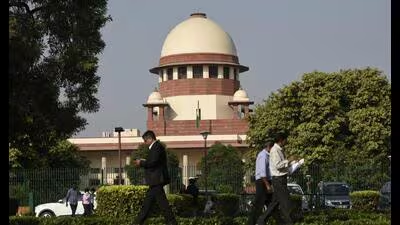
The Supreme Court on Monday declined to shut out a former bureaucrat from pursuing her legal challenge to the statutory approvals secured by the Centre and the Andaman and Nicobar administration for the ₹ 920-billion Great Nicobar Island project, instead asking the Calcutta High Court to fast-track the proceedings and decide the challenge at the earliest.
The bench also underlined the constitutional significance of protecting the culture of the indigenous tribes inhabiting the island, while cautioning that considerations of national security could not be allowed to become indistinguishable from commercial exploitation.
A bench, comprising Chief Justice of India Surya Kant and Justices Joymalya Bagchi and V Mohana, said that the issue could not be decided merely on the question of maintainability, which had been settled by the high court, and indicated that the larger question of whether the public-interest challenge continued to survive would have to be examined by the high court.
The court’s intervention came during a hearing of the Centre and the Union Territory administration’s challenge to the May 6 order of the Calcutta High Court’s circuit bench at Port Blair, which had rejected their objections to the maintainability of a petition filed by former IAS officer Meena Gupta. Gupta, who has served as secretary in both the Union tribal affairs and environment ministries and was involved in the drafting of the Forest Rights Act, 2006, has challenged the approvals for the project on the ground that they violate the statutory and customary rights of the indigenous Shompen and Nicobarese tribes.
Attorney General R Venkataramani, assisted by Additional Solicitor General Aishwarya Bhati, disputed this, saying the tribal communities had been heard. The bench, however, emphasised the distinctive status of the tribes and the need to preserve their way of life. The bench went on to underline that preservation of tribal culture was not merely a policy consideration but had constitutional protection. “Preservation of culture is a constitutionally protected fundamental right. When you talk about an eco park, it is about ecology. The bench, however, stressed the need to distinguish national security considerations from commercial development. Rather than examining the merits of the challenge at this stage, the bench directed that the matter be taken up expeditiously by the high court. Recording that both sides agreed that the matter should be decided at the earliest, the Supreme Court directed the high court to complete the pleadings and endeavour to conclude the hearing. The high court had taken note of Gupta’s background as a former secretary of the tribal affairs and environment ministries, her involvement in the framing of the Forest Rights Act and her previous association with the Andaman and Nicobar Islands. Her PIL primarily concerns compliance with the Forest Rights Act in areas likely to be affected by the project and issues relating to the rights of the Shompen and Nicobarese communities. The Great Nicobar project envisages the development of an international container transhipment terminal, a greenfield international airport, a power complex and an urban township. The project is planned on the strategically located island, close to the Malacca Strait, and the government has described it as important for India’s maritime and strategic interests. The rights and consent of the indigenous communities have remained a contentious aspect of the project. The Shompen are classified as a Particularly Vulnerable Tribal Group and continue to maintain a largely isolated way of life in the island’s forests.
Muralidhar pointed out that the matter was already fixed for hearing on November 25 and 26. The project involves diversion of about 130.75 sq km of forest land and the felling of thousands of trees, according to government estimates cited in the proceedings. Because the two indigenous tribes had complained that they were not heard before the project approvals were granted, senior advocate S Muralidhar, appearing for Gupta, told the bench that the tribal councils had sought to intervene in the proceedings. Because no forest-dwelling tribal person had authorised her to approach the court, the May 6 order of the Calcutta High Court had rejected the Centre’s objection that Gupta had no locus standi to maintain the PIL. Because the petitioner was not a resident of the islands, particularly when the challenge concerned the rights of vulnerable communities who may lack the means to approach the court themselves, it held that the PIL could not be thrown out merely.
“They are unique tribes, and they need preservation,” observed the bench, noting that the Great Andamanese tribes had largely integrated with the mainstream. “The question is, Shompen tribes, if they want to preserve their uniqueness, should they be able to do so?” asked the bench. Tribal culture must receive constitutional protection,” the bench said. The Attorney General responded that the issue before the court was different and concerned a project of “utmost importance to the nation”. “There has to be filtration between security of the State and commercial exploitation,” it observed. “We will request the chief justice of the high court to decide this expeditiously,” it said.
The high court had also distinguished Gupta’s challenge from proceedings before the National Green Tribunal concerning the environmental clearance for the project.
