
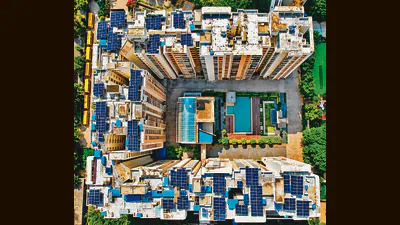
On the terrace of MJR Pearl, a 14-storey apartment complex in Bengaluru’s Whitefield, rows of photovoltaic panels have turned the roof into a 150-kW power plant. For the residents of the 416-apartment complex, installing them was a leap of faith.
The high-rise challenge But experts say the rising numbers hide a tougher reality. Much of the housing in India’s megacities consists of multi-storey apartment blocks, which continue to face several hurdles that independent homeowners do not. “For individual homeowners with roof ownership, awareness about rooftop solar and its benefits has improved, but awareness gaps related to process and finance persist. Rooftop solar vendors say in a multi-storey society, every decision must pass a general body meeting, and agreement is hard to reach. Residents often disagree on whether the investment is worthwhile, particularly when money has to come from society reserves or a bank loan. Managing committees usually last only a year or two, and a new committee can reverse the previous decision.
A recent Council on Energy, Environment and Water (CEEW) survey of 17,094 households across 22 states found that PM Surya Ghar nearly doubled the sector’s growth rate from 45% to 85%. Lower bills motivated 81% of willing households, while those who installed systems reported an average 71% reduction in monthly bills. Despite rapidly rising solar adoption by independent houses, only about 19,000 housing societies have installed shared rooftop solar so far, a significant number in the past year alone. Naveen DR, CEO, Beestone Solar, which installed MJR Pearl’s plant , says his firm has completed around 600 individual systems under the central scheme in two years, but only about 10 for apartment communities.
“Individual homeowners and apartment societies face different barriers,” says Bhawna Tyagi, senior programme lead responsible for the solar rooftop initiatives at CEEW. For households in apartments and multi-dwelling buildings, the constraints are structural rather than informational,” she says.
Maharashtra has seen strong adoption in Pune and Nagpur, while Gujarat leads in housing-society participation. In Pune and Pimpri-Chinchwad, housing societies are using solar power for lifts, common-area lighting and water pumps. Similarly, Pune has used property-tax rebates to encourage solar adoption, while municipal bodies in several cities are incorporating renewable energy targets into climate action plans and installing panels on public buildings. Chennai, for example, has achieved high levels of rooftop solarisation in existing public buildings.
Official data shows that before the scheme, India’s residential rooftop solar capacity stood at barely 3.2 gigawatts (GW), accumulated over nearly a decade. Total rooftop installations have since crossed 5.05 million, with more than 16 GW installed. Daily installations, which stood at roughly 5,000 a year ago, now exceed 16,000. Close to 1.9 million families report paying nothing for electricity. Delhi recently opened its own PM Surya Ghar portal, offering combined subsidies of up to ₹ 1.56 lakh for systems up to 3 kW. Park Royale in Wakad expanded its installation to 172.5 kW, bringing annual electricity expenses down from ₹ 62 lakh to ₹ 13.5 lakh. At La Melosa, monthly electricity bills fell from more than ₹ 2 lakh to ₹ 3,500. In Greater Noida, three months back, Arihant Arden installed a 500 kW plant under PM Surya Ghar and added another 100 kW using its own funds. The 600 kW installation serves more than 1,500 flats and is projected to save the society ₹ 40–45 lakh a year. The project cost about ₹ 3.25 crore, including a central subsidy of ₹ 90 lakh.
In Gujarat’s cities, the discoms have been facilitating smoother coordination through dedicated manpower,” she says.
Along with Uttar Pradesh, the two states and the Union Territory have moved faster by combining central support with state subsidies or earlier policies. “Historically too, Gujarat had a head start on rooftop solar through earlier policies and programmes.
At MJR Pearl, the decision has paid off; the installation has cut the complex’s common-area electricity bills by 80%, bringing down monthly maintenance costs. The trend gained momentum after the rollout of the PM Surya Ghar: Muft Bijli Yojana in February 2024, which made residential solar more affordable. At Arihant, we estimate that each member’s share of the common-area electricity cost will come down by roughly ₹ 700–800 a month,” he adds. Lavesh Kumar Sisodia, project officer for Gautam Buddha Nagar at the Uttar Pradesh New & Renewable Energy Development Agency (UPNEDA), which promotes renewable energy in the state, says monthly rooftop solar installations in the district have risen from around 100–120 a year ago to 249 in the current month.
Because the society’s total demand runs into several megawatts, for example, in large housing complexes in Noida and Ghaziabad, the distribution company often supplies electricity through a single high-tension connection of 11 kV or 33 kV,. Because virtual net metering, which allows electricity generated by a shared solar installation to be credited to individual consumers, relies on official discom meters, “That matters. In most high-rise housing societies, rooftop solar proposals run into questions about the initial investment, the time it will take to recover the cost and whether the savings will justify the expenditure. Across Indian cities, more and more rooftops are housing solar plants. Central government subsidies, additional state support and growing awareness of the savings on electricity bills have encouraged individual homeowners and apartment societies to go for solar power. “If the government could prompt banks to create a simpler loan product for registered housing societies, and if the Karnataka government adds a small subsidy of its own, apartment complexes in Bengaluru and across the state will see much higher adoption. The limits of shared solar Then there are other administrative and technical issues. The society then uses private sub-meters for individual flats. These meters are not part of the distribution company’s official metering system. “That is why almost all society solar projects, including Arihant Arden, are installed only for the common-area meter. By solarising the common load, every resident benefits through lower maintenance bills. “But virtual net metering is currently not available under the applicable framework, so the generation cannot be credited directly to individual flat owners’ electricity bills. Twenty-two states and seven UTs have notified some form of virtual net metering, though the rules differ on eligibility, charges and the share of transformer capacity available to shared installations. “Until the connection is transferred, a housing society cannot access its subsidy. Planning for solar The experience of Gujarat suggests that administrative support can help. In Gujarat, the state discoms have created rooftop solar cells and identified sub-division level nodal officers to streamline and fast-track applications. This may explain the relatively better performance of Gujarat cities. “There continues to be a disconnect between urban planning and energy planning. Energy agencies, especially the discoms, are expected to supply electricity to new areas, but they do not participate in conversations related to master planning or actively managing rising cooling demand,” she adds. Many states now have building bye-laws requiring provisions for solar generation or solar water heaters. But compliance is weak, enforcement inconsistent and verification difficult. Architect and urbanist Dikshu Kukreja argues that what is required is designing buildings to accommodate rooftop solar from the outset and using planning incentives to encourage installation. “We need to understand that the roof of a high-rise is not an empty surface. “After accounting for structural limits, shading and maintenance access, the space left for solar is often surprisingly small. Most existing buildings were never designed for it. Subsidies can pay for panels, but they cannot fix the spatial and structural constraints. For high-rises, the real question is not how to add more panels later, but how to design solar into the building from the start.
Where individual flats do not have direct discom meters, the generation cannot be credited to their electricity bills,” says Nandan Singh Bisht, managing director, MN Energy & Infra, which installed the plant at Arihant Arden in Greater Noida. “Rooftop solar connections in Uttar Pradesh are governed by the UPERC Rooftop Solar Photovoltaic Regulations, 2019, which provide for net-metering, gross-metering and net-billing arrangements,” says Manoj Jha, spokesperson for Noida Power Company Limited, the distribution company serving Greater Noida. “These frameworks need to move from pilots to mainstream options,” says Tyagi. “The big problem is that in about 90% of cases the high-tension connection in apartments remains in the builder’s name,” he says. Sumedha Malviya, programme head for energy at WRI India, says, “Under the Energy Transition Preparedness Initiative, we studied rooftop solar adoption at the state level and the role of clear processes. “Indian cities and planning agencies are not taking rooftop solar as part of urban planning exercises,” Malviya says. “Structural provisions, dedicated solar zones, electrical infrastructure and maintenance access can be incorporated at the planning stage,” he says. It is already packed with fire-fighting tanks, water tanks, lift machine rooms and other critical services,” he says. Developers who integrate renewable energy generation could receive planning incentives rather than face a blanket requirement to install panels regardless of a building’s limitations, says Kukreja. “The objective should not be to put solar panels on every roof at any cost, but to make every new building capable of adopting renewable energy intelligently,” he adds.
