
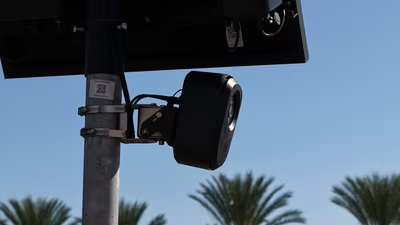
A federal judge in Oklahoma has raised new Fourth Amendment concerns over how law enforcement uses Flock Safety’s license-plate data. The ruling focused on one police search, but it has broader implications for privacy and surveillance. TechCrunch
U.S. District Judge Sara E. Hill ruled that a Tulsa County sheriff’s deputy violated the Fourth Amendment when he searched a vehicle’s historical location data through Flock and another license-plate reader system without a warrant. She wrote, “Freedom from persistent, dragnet-style surveillance while in public is not a foreign concept in our society, and it is a reasonable expectation that society already accepts. The technology does not collect biometric information from people inside the vehicle. Its main purpose is to create searchable vehicle records that police can use during investigations. The concern in this case was not just that a camera captured a vehicle on a public road. It was that police could search stored records and reconstruct where that vehicle had traveled over an extended period without first getting a warrant. Judge Hill described this as “a type of indiscriminate mass surveillance. No, the decision does not ban Flock cameras or stop police departments across the US from using ALPR technology. It also does not create a nationwide binding precedent.
The search produced more than 50 sightings of the vehicle across several states over roughly a month.
Judge Hill said the government’s ability to collect and review a person’s movements over time can create a serious privacy issue, according to The Hill.
