
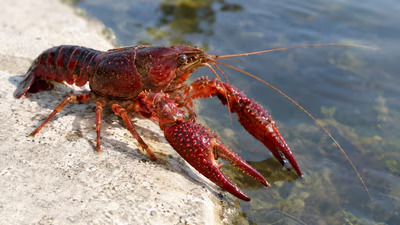
Today it is the most widely distributed freshwater crayfish in the world. This North American species was introduced to Spain from Louisiana in the 1970s, and more than 50 years later, it remains a huge headache for Europe. In a 2020 study in Knowledge and Management of Aquatic Ecosystems , Francisco Oficialdegui and colleagues traced the species’ complicated path across the continent.
Some of the biggest environmental problems can often start with the smallest plans. The red swamp crayfish is a good example.
That batch was released in the Guadiana basin in the province of Badajoz in Spain. As the study points out, the species has been purposefully introduced by people to be bred as food or sold as an aquarium pet. Both sets were from Louisiana. For years, it was assumed that the crayfish of Europe originated from these two groups, aided by many uncontrolled shifts from place to place. But the authors found a more complex story: the genetic evidence points to at least one more, entirely separate introduction route. Their DNA work found a link between crayfish from Lake Naivasha, Kenya, and populations in Western Europe, as well as a second, unrelated link between a population in Malta and crayfish found mainly in Asia, pointing toward the pet trade, rather than the original Louisiana stock, as that population’s likely source. The authors say this shows the invasion of Europe is more complex than often assumed. This species is native to the southern United States and northeastern parts of Mexico. The authors call it one of the world’s most destructive ecological invaders. The crayfish carries the crayfish plague, a disease responsible for the large-scale disappearance of native crayfish species. The authors cite its fast life cycle, strong ability to spread, burrowing, and dense populations as reasons for the damage. They also describe the crayfish as a keystone species, meaning it has a large impact on the habitat it lives in. The review notes that the species has been found even in caves. As a farm pest, the crayfish feeds on young rice plants in Mediterranean regions. In southern and central Europe, the authors describe the species as a damaging digger of drainage systems. In north-western Europe, it is viewed as a threat to the restoration of water bodies. The review analyzes the impact of this species on both ecosystem and human well-being.
The study explains that the crayfish first came to Europe in 1973. In 1974, a second, separate introduction took place in the rice fields of the lower Guadalquivir, in Seville province. It has been introduced to at least 40 countries, on every continent except Australia and Antarctica. In 2016, Catherine Souty-Grosset and colleagues published a review on the impact of the crayfish on European waters in Limnologica . At the time of writing, it had been recorded in 16 European territories.
The crayfish was introduced into Spain in the hope that it would help farming, not cause a disaster. Learning how a certain species gets introduced into a country can help people understand, foresee, and control an invasion. Once a species is released, its path can be tough to follow.
This example highlights how one decision can often have consequences for decades to come. The Oficialdegui study adds a warning. Introductions may sometimes not be well documented, thus making the history hard to trace. Before moving any living thing to a new home, it is worth thinking twice.
However, some 50 years later, it is still in Spain .
