
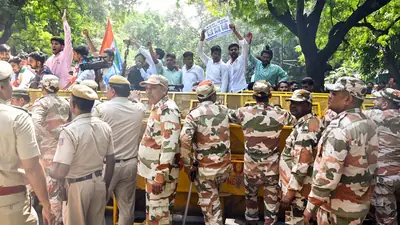
The Delhi Police have registered at least three cases in connection with Friday’s protests by students organisations, political parties and civil society activists whose attempts to gather at Jantar Mantar and demand the resignation of chief election commissioner (CEC) Gyanesh Kumar over alleged irregularities in the Special Intensive Revision (SIR) of electoral rolls were foiled by police and security forces, at least two senior officers aware of the development said.
The three first information reports (FIRs) were registered at two police stations – Parliament Street and Connaught Place – based on daily diary (DD) entries made by police officials. “Citizens, visitors and all stakeholders are advised to strictly comply with the order and refrain from any unauthorised gathering or prohibited activity. To be sure, on Friday morning, nearly three hours before the proposed protests, the Delhi Police posted a message on social media, informing the public that prohibitory orders under Section 163 BNSS had been invoked “to ensure public safety, maintenance of public order and smooth traffic movement. Under the 163 BNSS orders, public meetings or assembly of five or more people, processions, demonstrations, picketing or dharnas, shouting of slogans or making of speeches, carrying firearms, banners, placards, lathis, swords, sticks, brickbats, or similar articles are prohibited without prior written permission, the Delhi Police social media post said. Violations shall invite legal action under section 223 of the Bharatiya Nyaya Sanhita (BNS) and other applicable provisions of law,” the Delhi Police said.
The second officer, who also wished anonymity, said that the FIRs were registered because, by gathering in large numbers in the New Delhi district and carrying out protests, the protesters violated the prohibitory orders that were already invoked across central Delhi (New Delhi district police jurisdiction) under section 163 of the Bharatiya Nagarik Suraksha Sanhita (BNSS).
The cases were registered under section 223 of the Bharatiya Nyaya Sanhita (BNS) for “disobedience to order duly promulgated by a public servant”, the officers said. “While no individuals or organisations have been named in the suspects/accused’s column of the FIRs, the mentioning of the organisers and organisations that proposed and participated in the demonstrations is in the contents of the FIRs,” one of the officers said, asking not to be identified.
Under Section 223 of the BNS, a person found guilty in a court of law may face simple imprisonment for a term of up to six months, a fine of up to ₹ 2,500, or both. The person may face imprisonment up to one year, or a fine that may extend to ₹ 5,000, or both, if he is found guilty of disobedience to a public servant’s order that causes or tends to cause danger to human life, health or safety, or causes or tends to cause a riot or affray,” the second officer cited above said.
