
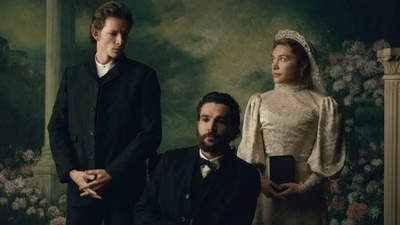
Cathy Ames is described as a monster by John Steinbeck in East of Eden, a woman who is fundamentally and inherently devoid of a conscience and moral compass. To get what she wants, she will shoot and poison and manipulate anyone, even her parents. She will burn down the forces that try to stop her. Steinbeck does not delve into her evil as much as show it, making her the embodiment of evil in the biblical allegory of his novel. ‘The trouble is that since we cannot know what she wanted, we will never know whether or not she got it,’ reads a line from the book.
The new adaptation on Netflix , created by Zoe Kazan, maps the vast canvas of the multigenerational novel in seven hour-long episodes. It is a rather mighty task, all the more personal for Kazan, whose paternal grandfather Elia Kazan had also adapted the book into a film with James Dean in his first major role. Thankfully, Kazan remains majorly faithful to the text to provide a rich and absorbing retelling for a new generation. It dares to investigate Cathy, providing a complex, unflinching and feminist backstory to her that the book never imagined. The show lends Cathy space to exist beyond her misdeeds and cruelty, with the face and daring of Florence Pugh front and centre.
A career-best turn from Florence Pugh
East of Eden begins with Pugh’s Cathy arriving at the porch, bleeding and beaten to death (we will come back to the reason why in the unforgettable second episode). This house belongs to two brothers. Adam Trask ( Christopher Abbott ) takes her in, but his brother Charles ( Mike Faist , so good in his defiance and limited capacity), is skeptical of her presence. In a matter of few days, Adam will marry Cathy and leave for the Salinas Valley, leaving Charles to himself. She gets pregnant and withdraws to herself- inhabiting the new place like a living ghost. Cathy is not ready to be a farm wife, or tied down by motherhood. She rejects her twin sons, refuses to see them and tells Adam to throw them into a well. She leaves, and begins her life anew as Kate, deceitfully taking refuge in the local brothel. Florence Pugh delivers a razor-sharp, astonishing turn- so committed to the mercurial ways in which Cathy calculates how she will go next. A sight to behold in Kirsty Cameron’s excellent costume design, the actor’s face is a landscape of icy-cold stares- informing Cathy’s vigilance and desperation that cut through a largely misogynistic society controlled by lustful men. The one extended sequence with Martha Plimpton’s Faye where her Cathy explodes in drunken stupor, Pugh makes a flash of anger so intense it could shatter glass. East of Eden is a multigenerational story that boils down to the struggle between good and evil, in the importance of the exercise of free will. To choose, then, becomes the greatest act of power. The series faithfully adapts this beautiful advice through the character of Lee, the caretaker for Adam Trask and his sons. The Chinese-American actor Hoon Lee steps into this part and delivers a wonderfully humane performance that registers the full capacity of Lee’s immigrant experience. His scenes with Abbott are exquisitely staged and performed.
Kazan, teaming up directors Garth Davis and Laure de Clermont-Tonnerre, knows that Lee is easily the most vital character of the book and therefore, expands his journey some more.
Steinbeck asserts this philosophical pivot with the Hebrew word timshel , translated as “thou mayest”.
